
Sudoku 88 98 79 e

数独 88 98 79 e
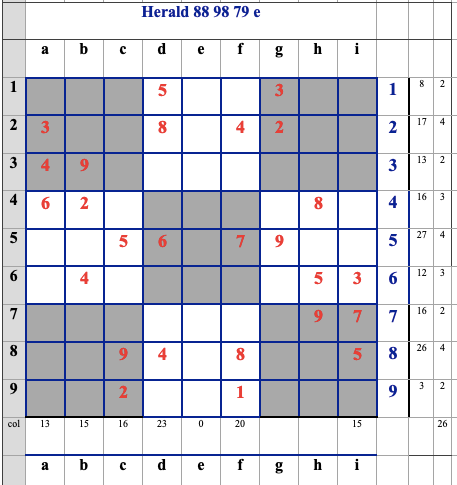
Sudoku is NOT a guessing game. To solve a Sudoku Challenge we need to be logical, to be able to explain every digit placed in a cell. We need to name those cells so that we can refer to each cell when discussing our logic with friends in a zoom meeting. We name the nine columns in the first nine alphabets, ( a ) right through to ( i ) and to name the nine rows in the first nine digits, ( 1 ) right through to ( 9 ). The nine boxes are also named Box1, Box 2, and so on right through to Box 9, from left to right, top first to bottom.
数独不是猜谜游戏。要解决数独挑战,我们需要有逻辑性,能够解释单元格中的每个数字。我们需要命名这些单元格,以便在缩放会议中与朋友讨论我们的逻辑时可以引用每个单元格。我们用前九个字母命名九列,从 (a) 一直到 (i),用前九个数字命名九行,从 (1) 一直到 (9)。这九个盒子也被命名为盒子 1、盒子 2,以此类推,从左到右,从上到下,一直到盒子 9。
Next we need to count the number of exposed cells - cells with numbers. In the above Sudoku challenge, we count these exposed cells in column ( l ), row 1 has 2 exposed cells, row 2 has 4 and so on. If the total of such exposed cells is less than 26, it is very likely that the Sudoku challenge cannot be solved as the challenge was produced by a computer generated program done by computer logic, not human logic.
接下来我们需要计算暴露细胞的数量——有数字的细胞。在上面的数独挑战中,我们在列 (l) 中计算这些暴露的单元格,第 1 行有 2 个暴露的单元格,第 2 行有 4 个,依此类推。如果此类暴露单元的总数少于 26,则很可能无法解决数独挑战,因为该挑战是由计算机逻辑而非人类逻辑完成的计算机生成程序产生的。
Here in the example above, there are twenty-six exposed cells - the minimum required for us to start thinking of a solution.
We also count the totals of the numbers in each row at column ( k ). When completed each row must produce a total of 45. Likewise, we track the totals of the numbers in each column and record these at row 10. Again, the total of each column must be 45, when completed.
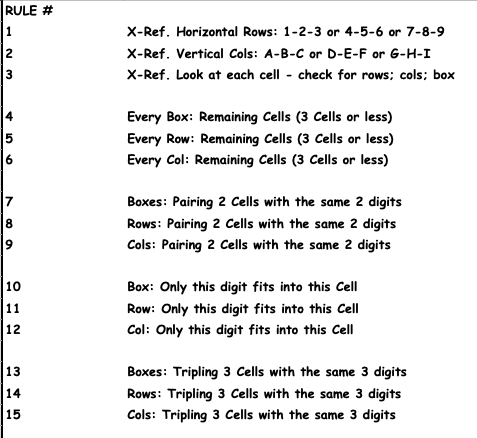
Let us start solving this challenge using the Francis’ Rules for Sudoku. These fifteen rules are shown in the table below:
在上面的示例中,有 26 个暴露的单元格 - 这是我们开始考虑解决方案所需的最低要求。
我们还计算了第 (k) 列每行中数字的总数。完成后,每一行的总数必须为 45。同样,我们跟踪每一列中数字的总数,并将其记录在第 10 行。同样,完成后,每一列的总数必须为 45。
让我们开始使用弗朗西斯的数独规则来解决这个挑战。这十五条规则如下表所示.
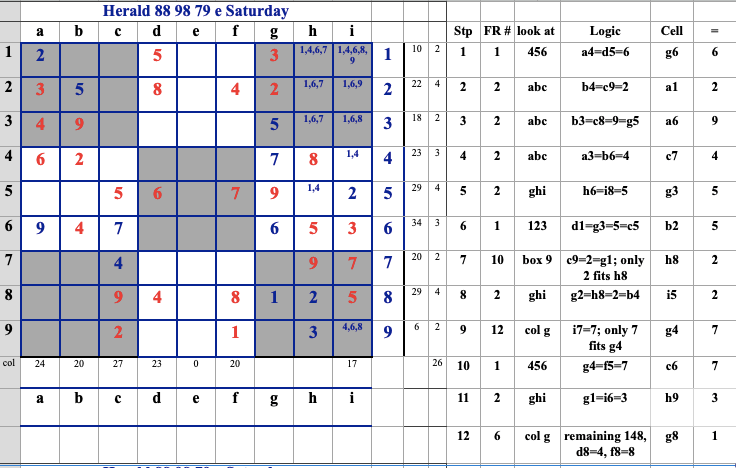
We can easily follow the logic by reading the table on the right-hand side of the photograph above.
Step # 1: Francis’ Rule # 1: Look at rows 456: Cell a4 = Cell d5 = 6: So Cell g6 = 6.
| Step # 2: Francis’ Rule # 2: Look at columns abc: b4 = c9 = 2: So, Cell a12. Follow the steps # 3 to #12 shown in the right-hand side of the table above. The results of these twelve numbers are illustrated in the photograph above on the left-hand side. |
我们可以通过阅读上图右侧的表格轻松地遵循逻辑。
步骤 # 1:Francis 规则 # 1:查看第 4,5,6 行:单元格 a4 = 单元格 d5 = 6:所以单元格 g6 = 6。
步骤 # 2:Francis 规则 # 2:查看 abc 列:b4 = c9 = 2:因此,单元格 a12。
按照上表右侧显示的步骤#3 到#12 进行操作。这十二个数字的结果显示在左手边的照片中。
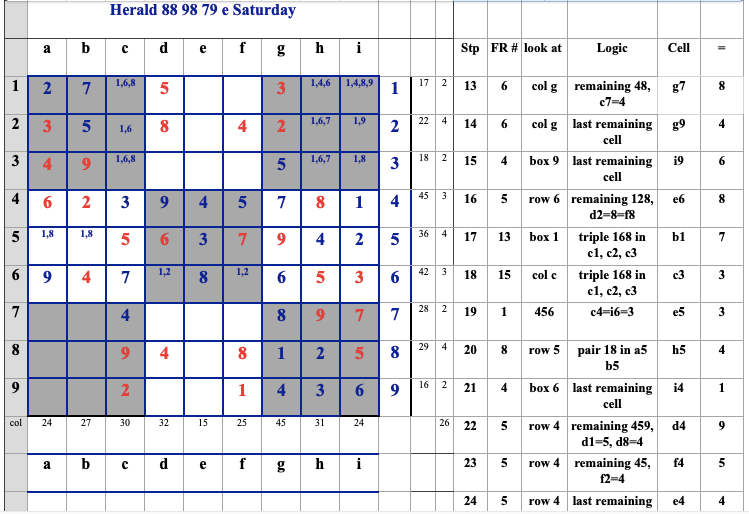
Steps # 22, # 23, and # 24: Francis’ Rule # 5 - Remaining cells in row 4: Remaining digits in the three cells are 4,5, and 9. Cell d1 = 5 and Cell d8 = 4; So cell d4 = 9. Then Cell f2 = 4; So Cell f4 = 5. Last remaining cell and number - Cell e4 = 4.
步骤#22、#23 和#24:Francis 规则#5 - 第 4 行中的剩余单元格:三个单元格中的剩余数字为 4,5 和 9。单元格 d1 = 5 和单元格 d8 = 4;所以单元格 d4 = 9。然后单元格 f2 = 4;因此,单元格 f4 = 5。最后剩余的单元格和编号 - 单元格 e4 = 4。
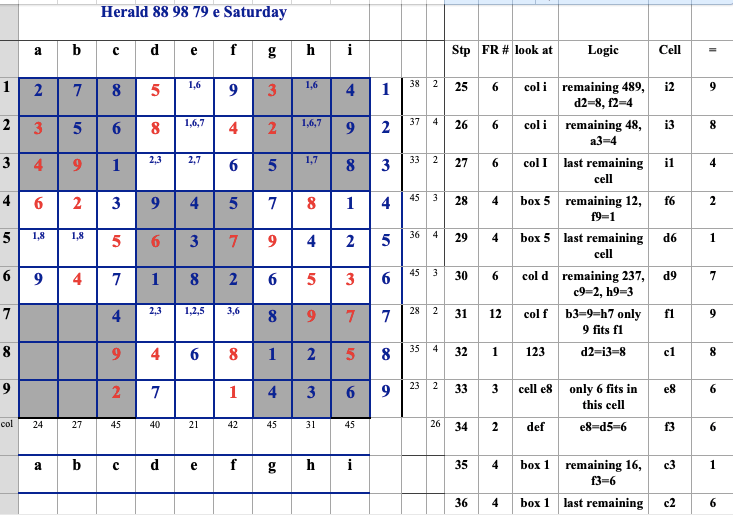
Steps # 35 and # 36: Francis’ Rule # 4: Remaining numbers 1 and 6 in Box # 1: Cell c3 = 1; Cell c2 = 6.
步骤 # 35 和 # 36:Francis 规则 # 4:方框 # 1 中剩余的数字 1 和 6:单元格 c3 = 1;单元格 c2 = 6。
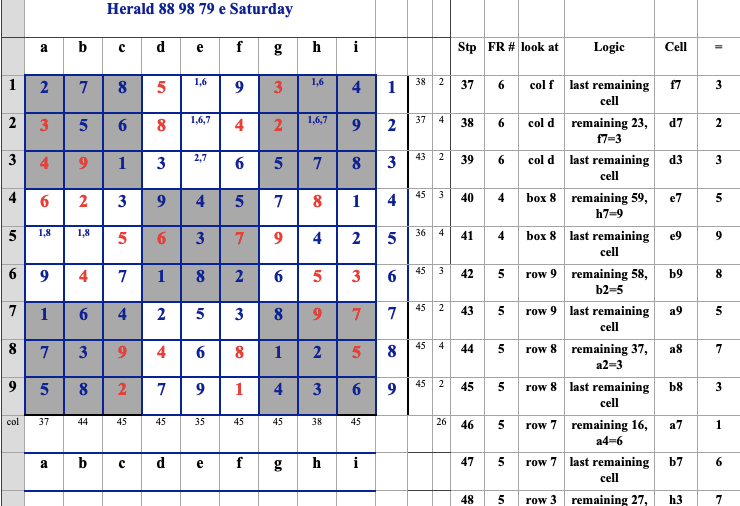
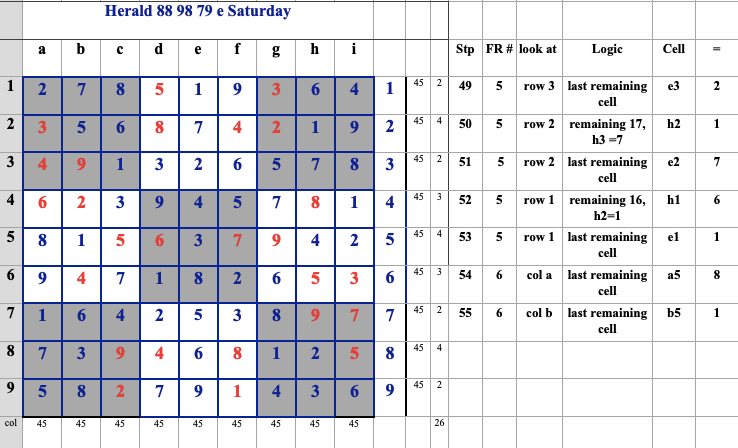
The last eighteen steps are relatively easy, basing on the remaining numbers in the remaining cells of a Box, or of a Row, or of a Column.
最后十八个步骤相对简单,基于 Box、Row 或 Column 的剩余单元格中的剩余数字。
 English