
Sudoku Logic

数独逻辑 Shù dú luó jí
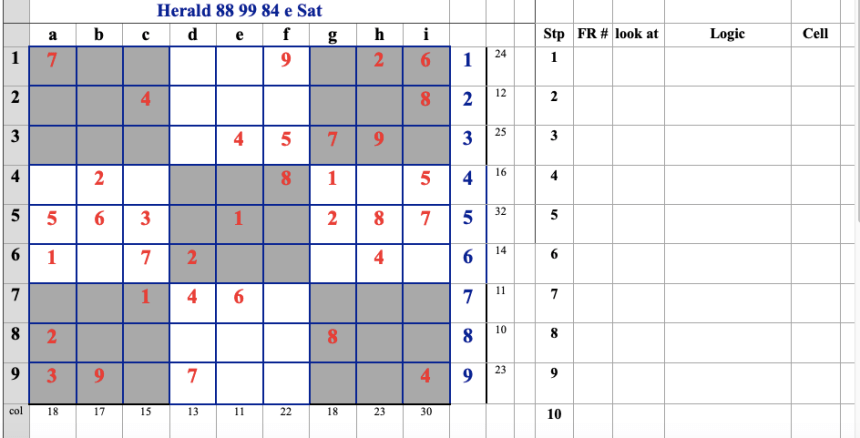
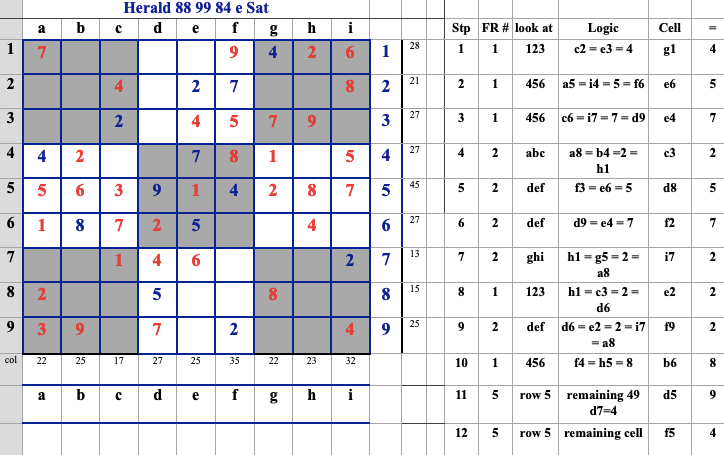
Let us start by revising the fifteen Francis’ rules for Sudoku. The first three rules are collectively known as the Cross-Referencing Rules, where we have to look at the rows (horizontally) in groups of three, rows 1, 2, and 3 first, then rows 4, 5, and 6, and then 7, 8, and 9 - Rule # 1. In the above case, looking at rows 1, 2, and 3, we have a “4” in cell c2 and another “4” in cell e3. This means that cell g1 has to be a “4”. we record this first step as: Step # 1; Francis’ Rule # 1; Look at rows 123; Logic: c2 = e3 = 4; Cell g1 = 4.
Looking at rows 1, 2, and 3 once again there are two “7”s at cells a1 and g3 but unfortunately we can only conclude that one of the three sells at d2, f2, and g2 is a “7” and there is therefore no solution of the “7” in row 2 as yet.
We now look at rows 4, 5, and 6. Here, a5 = i4 = 5 = f6. So, under the same Francis’ Rule # 1, e6 = 5 (Step # 2). Then looking at the same rows 4, 5, and 6, we have c6 = i7 = 7 = d9, so e4 = 7 (Step # 3, also Francis’ Rule # 1.)
We now come to Francis’ Rule # 2 - Cross referencing but using columns (looking vertically instead of horizontally) starting with columns a, b, c; then columns e, f, g; and then h, I, j; instead of rows. Looking at columns abc we have a8 = b4 = 2 = h1, therefore cell c3 = 2. (Step # 4 - Francis’ Rule # 2).
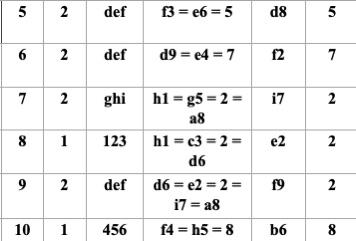
In the similar manner, we can follow steps # 5 to #10 using Francis’ Rule # 1 (horizontally in rows) and Francis’ Rule 2 (vertically in columns).
The results are: cell d8 = 5; cell f2 = 7; cell i7 = 2; cell e2 = 2; cell f9 = 2; and cell b6 = 8.
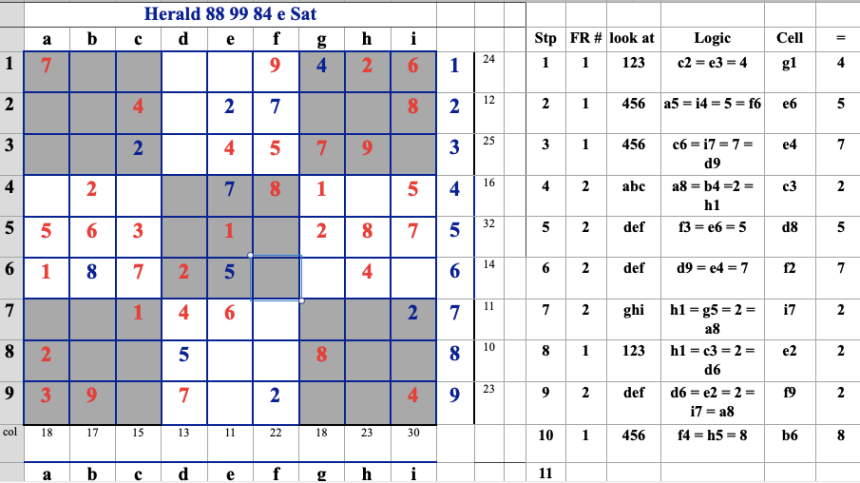
Francis’ Rule # 3, which is also a cross-referencing rule, applies when a cell has to be just one digit, after looking at both the horizontal rows and the vertical columns associated with that particular cell. This rule can be found in step # 16 in our solution to our sample puzzle, shown below.
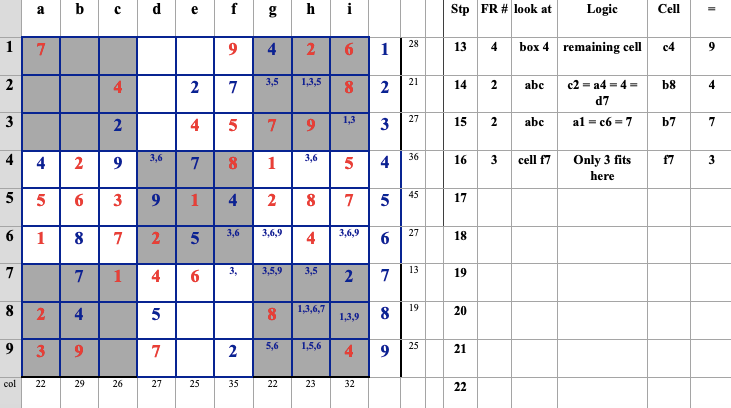
At that point in the puzzle, cell f7 can only be the number ‘ 3 ‘ because cell c7 = 1; cell i7 = 2; cell d7 = 4; cell f3 = 5; cell e7 = 6; cell f2 = 7; cell f4 = 8; and cell f1 = 9.
The next group of Francis’ Rules is termed the “Remaining cells” where (1) a box contains three or less unknown numbers - Rule # 4; (2) a row contains three or less unknown numbers - Rule # 5; and (3) a column contains three or less unknown numbers - Rule # 6. There are nine boxes in Sudoku, Box # 1 describes the nine cells a1, a2, a3, b1, b2, b3 and c1, c2, c3; Box # 2 consists of the nine cells of d1, d2, d3, e1, e2, e3, f1, f2, f3; and so on until Box # 9 having the nine cells of g7, g8, g9, h7, h8, h9, i7, i8, i9.
The solution to our sample puzzle provides examples of these three rules at steps # 11, 12, and 13 and then at steps # 16 and 17.
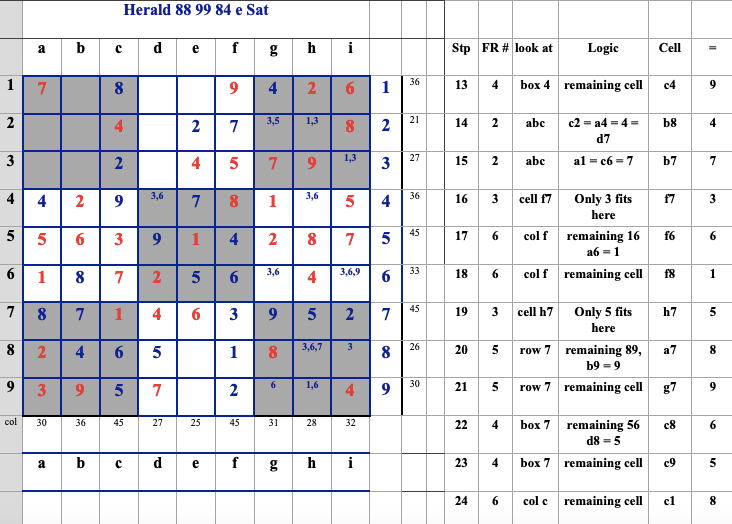
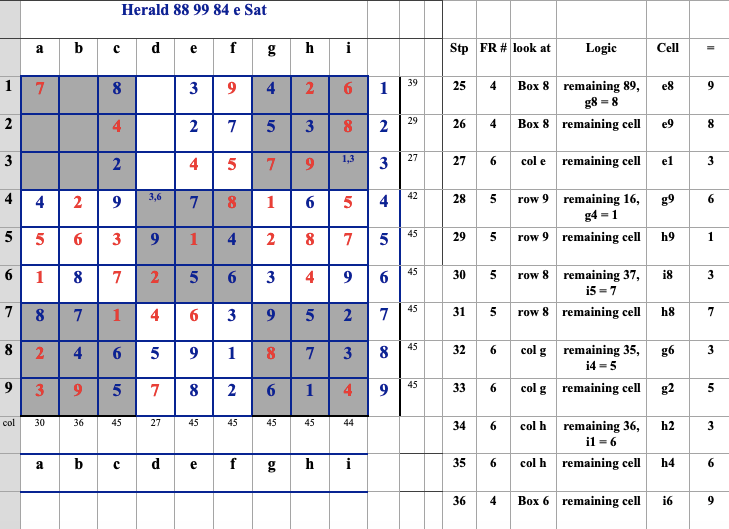
We can see that this entire puzzle can be solved using just these six Francis’ Rules.
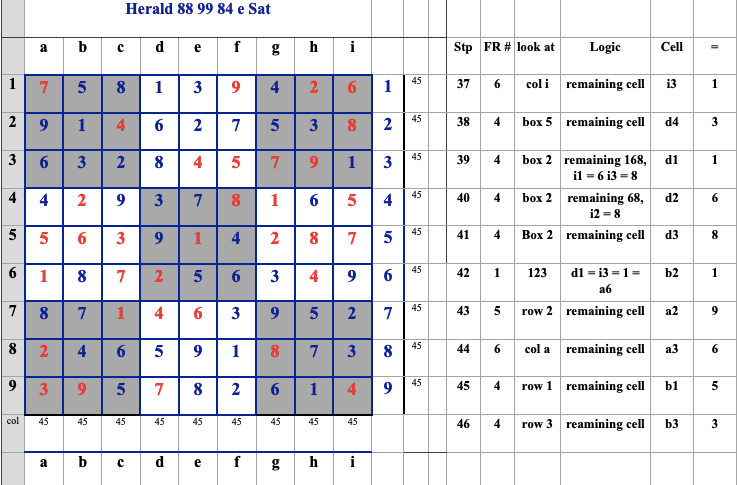
The remaining Francis’ Rules # 7 to 15 can briefly be explained below. These are used for more difficult Sudoku puzzles.
The Pairing Rules # 7, 8, and 9 where two cells in a box (Francis’ Rule # 7) or row (Francis Rule # 8), or column (Francis’ Rule # 9) have the same two possible digits, leaving us to be able to solve for other cells in the same box (Francis’ Rule # 7), or row (Francis Rule # 8), or column (Francis’ Rule # 9).
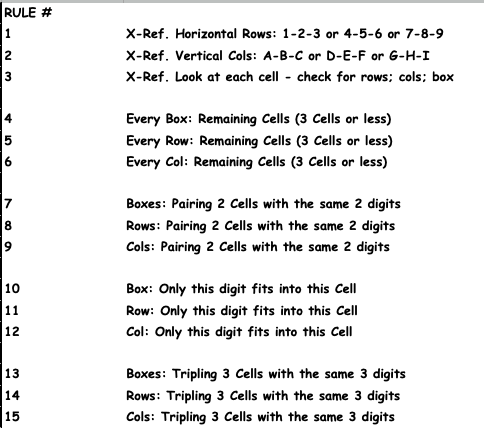
Francis’ Rules # 10, 11, and 12 are similar to Francis’ Rule # 3 except that this time the ‘only digit fits a cell’ is in the context of a box (Francis’ Rule # 10) or a row (Francis’ Rule # 11), or a column (Francis’ Rule # 12).
The last three rules Francis’ Rules # 13, 14, and 15 are similar to Francis’ Rules # 7, 8, and 9 except this time there are three cells with the same three digits in then within a box, a row, or a column.
Look up some further examples where the full fifteen Francis’ Rules are shown.
朗西斯的数独规则
规则 #
1 X-参考。水平行:1-2-3 或 4-5-6 或 7-8-9
2 X-参考。垂直列:A-B-C 或 D-E-F 或 G-H-I
3 X-参考。查看每个单元格 - 检查行;列;盒子
4 每盒:剩余电池(3 电池或更少)
5 每水平行:剩余单元格(3 个单元格或更少)
6 每直列:剩余细胞(3 个细胞或更少)
7 每盒:将 2 个单元格与相同的 2 个数字配对
8 每水平行:将 2 个单元格与相同的 2 个数字配对
9 每直列:将 2 个单元格与相同的 2 个数字配对
10 每盒:只有这个数字适合这个Cell
11 每水平行:只有这个数字适合这个单元格
12 每直列:只有这个数字适合这个单元格
13 每盒:三倍 3 个具有相同 3 位数字的单元格
14 每水平行:将具有相同 3 位数字的 3 个单元格增至三倍
15 每直列:将具有相同 3 位数字的 3 个单元格增至三倍
Guīzé#
 English