
Easy Sudoku? 容易的数独吗?
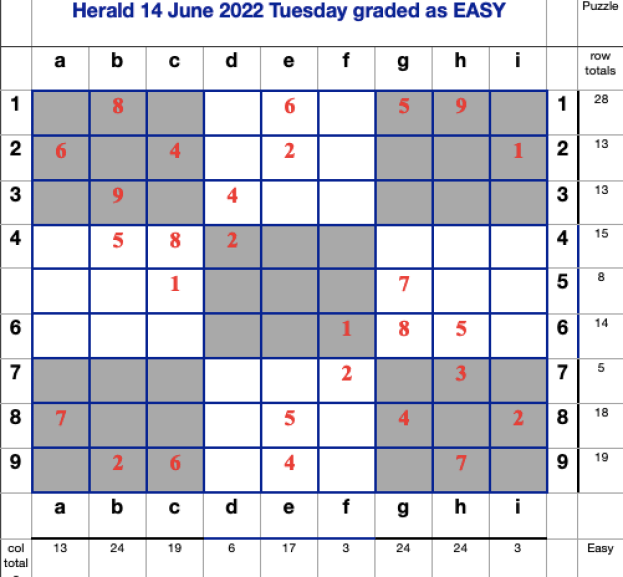
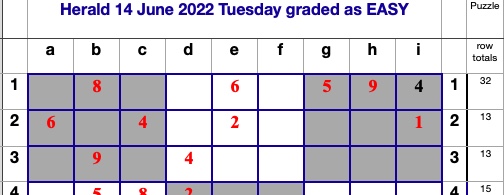
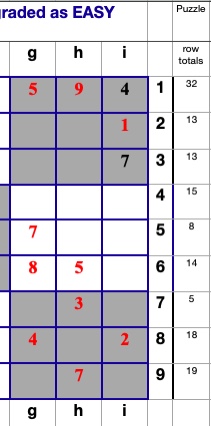
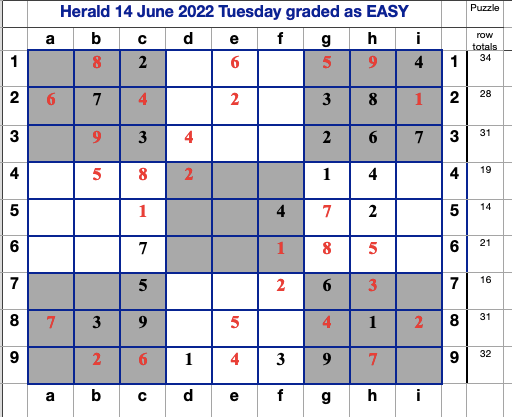
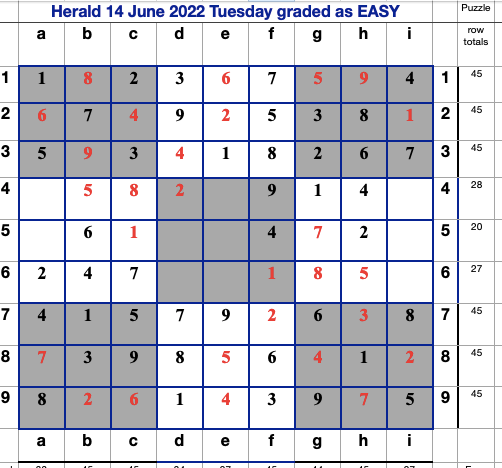
The EASY Sudoku Challenge of the NZ Herald published on Tuesday June 14th 2022 is tabulated s follows, with our usual reference to Columns (Column a to i) an to Rows (Rows 1 to 9).
新西兰先驱报于 2022 年 6 月 14 日星期二发布的 EASY Sudoku 挑战列表如下,我们通常参考列(a 到 i 列)和行(第 1 到 9 行)。
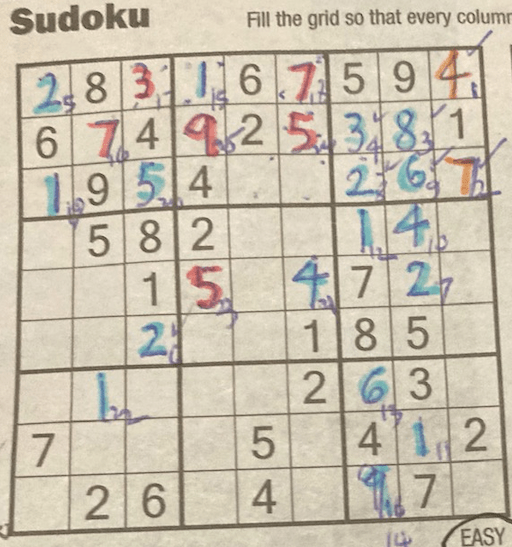
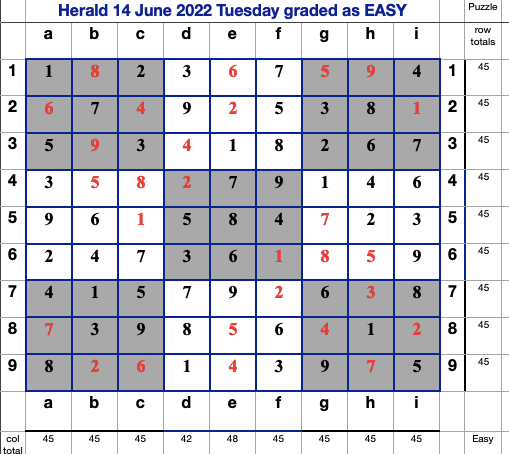
We can try to solve this Sudoku challenge now and very soon, at around step 15, we will find that this challenge is not as EASY as it appears. We have reclassified this Sudoku challenge as “HARD”. The reason is that we have made four attempts as shown in our photographs below before we finally got a solution.
我们现在可以尝试解决这个数独挑战,很快,在第 15 步左右,我们会发现这个挑战并不像看起来那么容易。我们已将此数独挑战重新归类为“困难”。原因是在我们最终得到解决方案之前,我们已经进行了四次尝试,如下图所示。
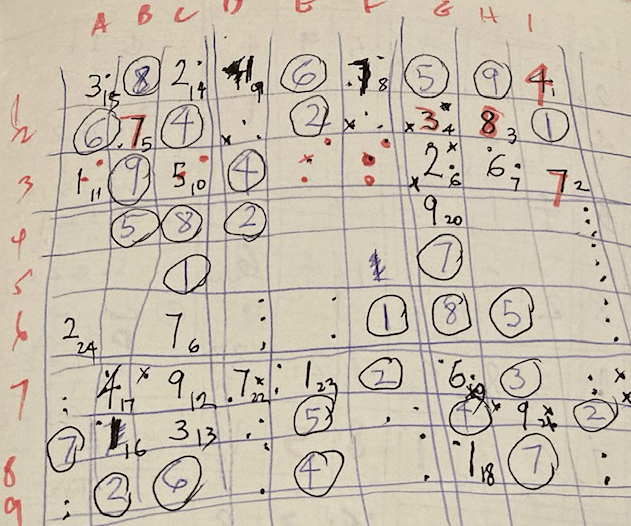
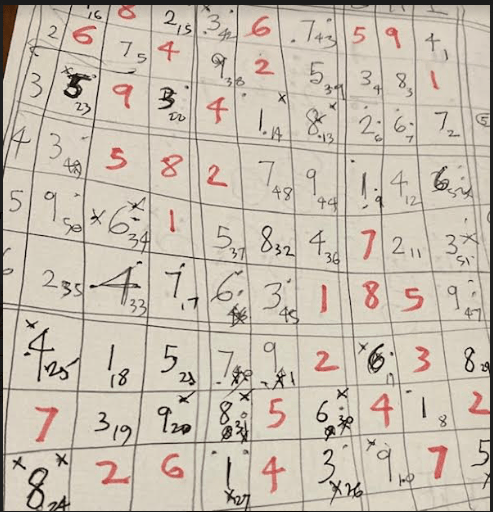
Let us now do this challenge together, using the fifteen Francis’ Rules for Sudoku.
现在让我们一起使用弗朗西斯的十五条数独规则来完成这个挑战。
Using Francis’ Rule # 1 looking at rows 1, 2, and 3 we have cell c2 = cell d3 = 4. Therefore, the cell a1 (the only blank cell for Box 3 in row 1) is equal to 4. Correct?
使用 Francis 的规则 #1 查看第 1、2 和 3 行,我们有单元格 c2 = 单元格 d3 = 4。因此,单元格 a1(第 1 行中框 3 的唯一空白单元格)等于 4。对吗?
Using Francis’ Rule # 2 looking at columns g, h, and i we have cell g5 = cell h9 = 7. Therefore, the cell i3 (the only blank cell for Box 3 in column i) is equal to 7.
使用 Francis 的规则 #2 查看 g、h 和 i 列,我们有单元格 g5 = 单元格 h9 = 7。因此,单元格 i3(第 i 列中框 3 的唯一空白单元格)等于 7。
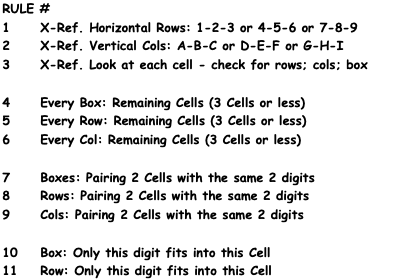
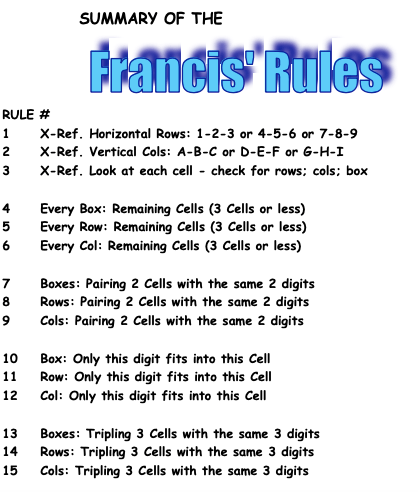
Just for revision, let us recapitulate what the Francis’ Rules are.
让我们再看看弗朗西斯的规则。这十五条弗朗西斯的规则是什么?
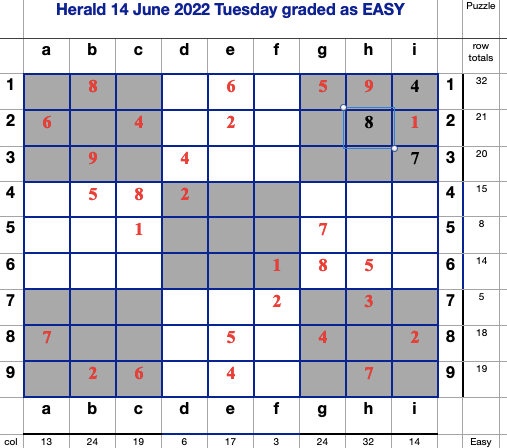
Let us now take a closer look at Cell h2. Look at the digits around this cell, that can have an effect on the digit for this cell. We have i2 = 1; e2 = 2; h7 = 3; i1 = 4; g1 = 5; a2 = 6; i3 = 7; and h2 = 9. With such a surrounding, cell h2 must be equal to 8 and this is Francis’ Rule # 3.
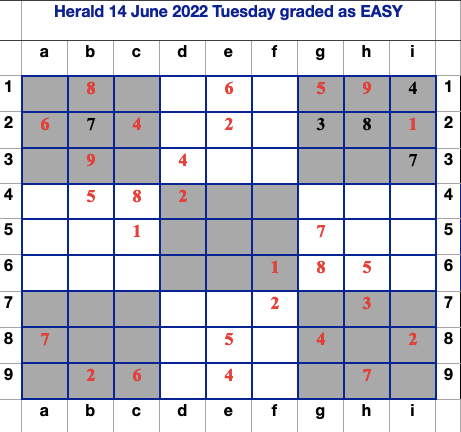
In a similar manner, also using Francis’ Rule # 3, we take a closer look at Cell g2 and its surrounding cells with digits already known. We have i2 = 1; e2 = 2; i1 = 4; g1 = 5; a2 = 6; i3 = 7; h2 = 8; and h1 = 9. Therefore cell g2 must be equal to 3.
现在让我们仔细看看 Cell h2。查看此单元格周围的数字,这可能会影响此单元格的数字。我们有 i2 = 1; e2 = 2; h7 = 3; i1 = 4; g1 = 5; a2 = 6; i3 = 7; h2 = 9。在这样的环境下,单元格 h2 必须等于 8,这是 Francis 的规则 #3。
以类似的方式,同样使用 Francis 的规则 #3,我们仔细观察单元格 g2 及其周围的单元格,其中数字已知。我们有 i2 = 1; e2 = 2; i1 = 4; g1 = 5; a2 = 6; i3 = 7; h2 = 8;和 h1 = 9。因此单元格 g2 必须等于 3。
We next look at Row 2. There are three cells remaining and three missing digits 5, 7, 9 missing in this row. Using Francis’ Rule # 5, we see that cell b4 = 5 and cell b3 = 9. Therefore it is logical that cell b2 must equal to 7.
我们接下来看第 2 行。这行中剩下三个单元格和三个缺失的数字 5、7、9。使用 Francis 的规则 #5,我们看到单元格 b4 = 5 和单元格 b3 = 9。因此,单元格 b2 必须等于 7 是合乎逻辑的。
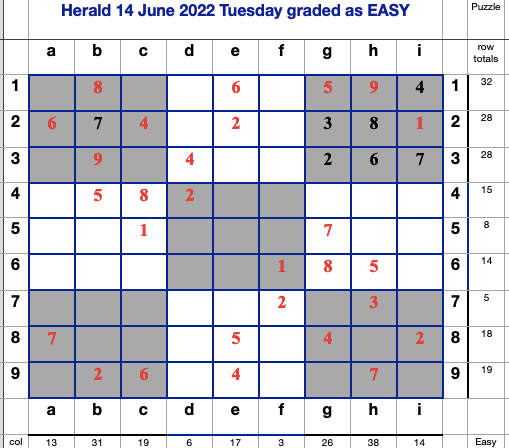
This is the time that we see that this challenge cannot be classified as EASY. At this point we need to think deeper into Francis’ Rules 10, 11, and 12 - the ‘Only Fit’ Rules. Let us take a look at column G. There are four vacant cells here - cells g3, g4, g7 and g9. We have cell d4 = 2, so cell g4 cannot be 2. We have cell f7 = 2, so cell g7 cannot be the digit 2. We have cell b9 = 2, so cell g9 also cannot be the digit 2. Thus for column g, only g3 = 2. This is the ‘Only Fit’ rule under Francis’ Rule # 12 (for column).
Then, for Box 3 (that is the box with cells g1, g2, g3, h1, h2, h3, i1, i2, and i3) there is only one cell remaining vacant, cell h3, Therefore under Francis’ Rule # 4, cell h3 = 6.
这是我们看到这个挑战不能被归类为简单的时候。在这一点上,我们需要更深入地思考弗朗西斯的规则 10、11 和 12——“仅适合”规则。让我们看一下 G 列。这里有四个空单元格 - 单元格 g3、g4、g7 和 g9。我们有单元格 d4 = 2,所以单元格 g4 不能是 2。我们有单元格 f7 = 2,所以单元格 g7 不能是数字 2。我们有单元格 b9 = 2,所以单元格 g9 也不能是数字 2。因此对于列g,只有 g3 = 2。这是 Francis 规则 #12 下的“仅适合”规则(用于列)。
然后,对于方框 3(即包含单元格 g1、g2、g3、h1、h2、h3、i1、i2 和 i3 的方框),只有一个单元格剩余空置,单元格 h3,因此根据弗朗西斯规则#4,单元格 h3 = 6。
In column h, the three digits remaining are 1, 2, and 4. Under Francis’ Rule # 6 (remaining digits in column) we have cell d4 = 2 and cell i8 = 2. Therefore cell h5 = 2. After this, the remaining digits for column h are 1 and 4 and thus, when we have cell g8 = 4, cell h8 must equal to 1 and cell h4 = 4.
在 h 列中,剩余的三位数字是 1、2 和 4。根据 Francis 的规则 #6(列中的剩余数字),我们有单元格 d4 = 2 和单元格 i8 = 2。因此单元格 h5 = 2。在此之后, h 列的剩余数字是 1 和 4,因此,当我们有单元格 g8 = 4 时,单元格 h8 必须等于 1 并且单元格 h4 = 4。
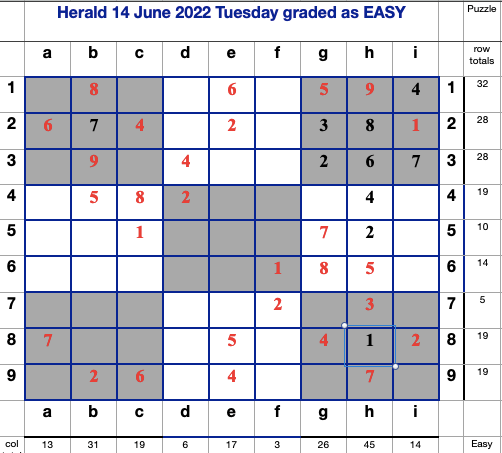
In a similar manner, we look at column g. The remaining digits here are 1, 6, and 9. When we have cell h1 = 1, both cells g7 and g9 cannot equal to 1 as they belong to the same box, Box 9. So, cell g4 = 1. Then with cell c9 = 6, cell g9 must equal to 9 and the last digit in column g, cell g7 = 6.
以类似的方式,我们查看 g 列。这里剩下的数字是 1、6 和 9。当我们有单元格 h1 = 1 时,单元格 g7 和 g9 不能等于 1,因为它们属于同一个框,即框 9。所以,单元格 g4 = 1。然后有单元格c9 = 6,单元格 g9 必须等于 9,并且 g 列中的最后一位数字,单元格 g7 = 6。
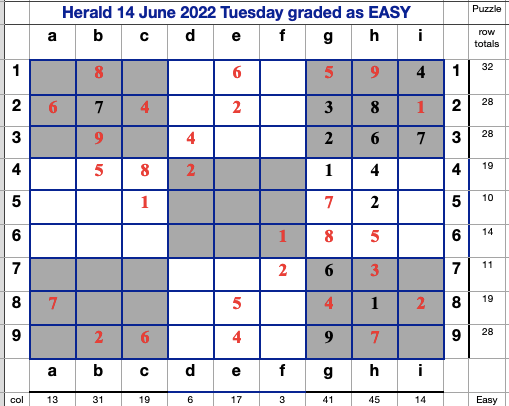
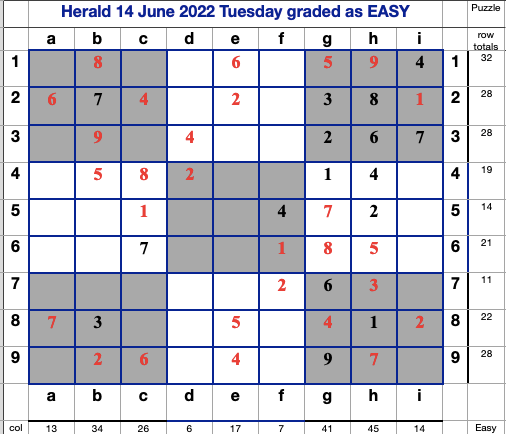
We go through the process of the Francis’ rules again and note that in columns a, b, and c, there are digit 7’s in cells b2 and a8, leaving us an answer to cell c6 in box 4. So under Francis’ Rule # 2, Cross Referencing in columns, we have cell c6 = 7.
Also, in columns d, e, and f, also under Francis’ Rule # 2, we have cell d3 = 4 = cell e9 = cell h4. That gives us cell f5 of box 5 the same digit of 4.
We now look at cell b8 and its surrounding cells. We note that cell h8 = 1; cell i8 = 2; cell g8 = 4; cell e8 = 5; cell e1 = 6; cell a8 = 7; cell b1 = 8; and cell b3 = 9. This means that cell b8 = 3. Francis’ Rule # 3.
我们再次经历弗朗西斯规则的过程,并注意到在 a、b 和 c 列中,单元格 b2 和 a8 中有数字 7,在方框 4 中留下单元格 c6 的答案。所以根据弗朗西斯规则# 2,列中的交叉引用,我们有单元格c6 = 7。
此外,在 d、e 和 f 列中,同样根据 Francis 的规则 #2,我们有单元格 d3 = 4 = 单元格 e9 = 单元格 h4。这给了我们框 5 的单元格 f5 相同的数字 4。
我们现在看一下单元格 b8 及其周围的单元格。我们注意到单元格 h8 = 1;单元格 i8 = 2;单元格g8 = 4;单元格 e8 = 5;单元格 e1 = 6;单元格 a8 = 7;单元格 b1 = 8;和单元格 b3 = 9。这意味着单元格 b8 = 3。弗朗西斯规则 #3。
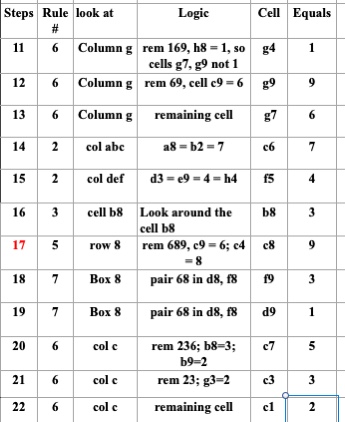
The next six steps (from step # 17 to step # 22) have been tabulated below. Cell c8 = 9 can be found by looking at the remaining three digits 6, 8, and 9 to fit into three cells (Francis’ Rule # 5). Cell c8 = 9 because two cells that are related to cell c8 with digits 6 and 8 have been located.
下面列出了接下来的六个步骤(从步骤#17 到步骤#22)。可以通过查看剩余的三个数字 6、8 和 9 来找到单元格 c8 = 9,以适应三个单元格(弗朗西斯规则 #5)。单元格 c8 = 9,因为已找到两个与单元格 c8 相关的数字为 6 和 8 的单元格。
Steps # 18 and 19 relate to box # 8 where there is a pair found in cell d8 and f8 (both these cells have digits 6 and 8 in them). So, by a process of elimination, we can find the digits for cell f9 (which is 3) and for cell d9 (which is 1). Francis’ Rule # 7.
Steps # 20 to 22 related to column c where only three digits will fit into three cells of c1, c3, and c7.
步骤 #18 和 19 与框 #8 相关,其中在单元格 d8 和 f8 中找到一对(这两个单元格中都有数字 6 和 8)。因此,通过消除过程,我们可以找到单元格 f9(即 3)和单元格 d9(即 1)的数字。弗朗西斯的规则#7。
步骤 # 20 到 22 与 c 列相关,其中只有三个数字适合 c1、c3 和 c7 的三个单元格。
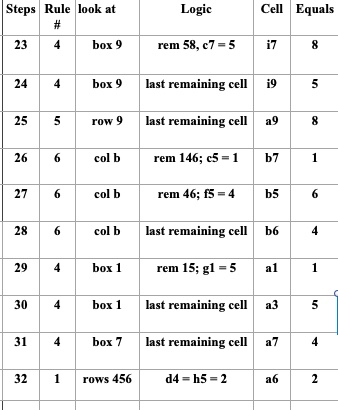
Now for the rest of the solution, the following tabulated answers are self explanatory and simple to follow. It centres on the first three sets of Francis’ Rules - Cross References (Rules 1, 2, and 3); Remaining Cells (Rules 4, 5, and 6); and Pairing two digits to two cells (Rules 7, 8, and 9).
Steps 23 to 32 are as follows. They concern Boxes # 1; # 4; and # 7; Row 9; and Column b.
现在对于解决方案的其余部分,以下表格答案是不言自明且易于理解的。它以弗朗西斯的前三组规则为中心——交叉引用(规则 1、2 和 3);剩余单元格(规则 4、5 和 6);和 将两个数字与两个单元格配对(规则 7、8 和 9)。
步骤23至32如下。它们涉及方框#1; #4;和#7;第 9 行;和 b 列。
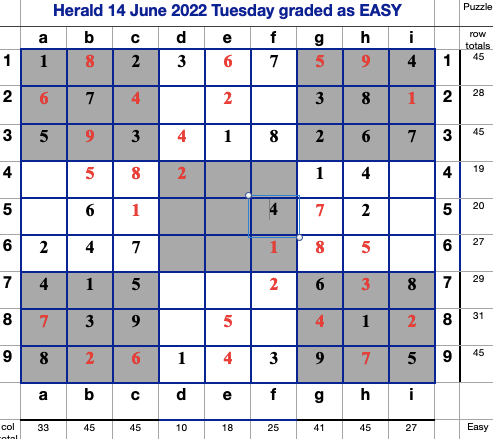
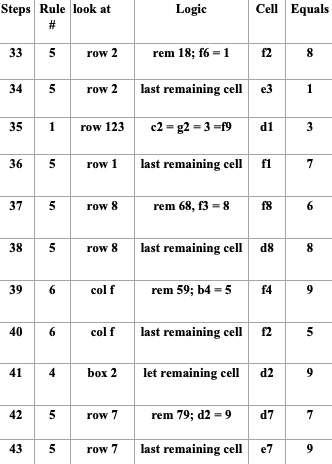
The Steps 33 to 43 are shown below:
步骤 33 至 43 如下所示:
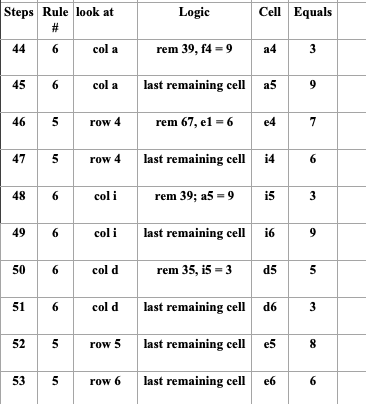
Finally, the steps 44 to 53 are as follows:
最后,步骤44至53如下:
 English