
Nerdle for July 2022 年七月的数子游戏
We start by googling “needle” and selecting the website nerdlegame.com. We should get the following screen display:
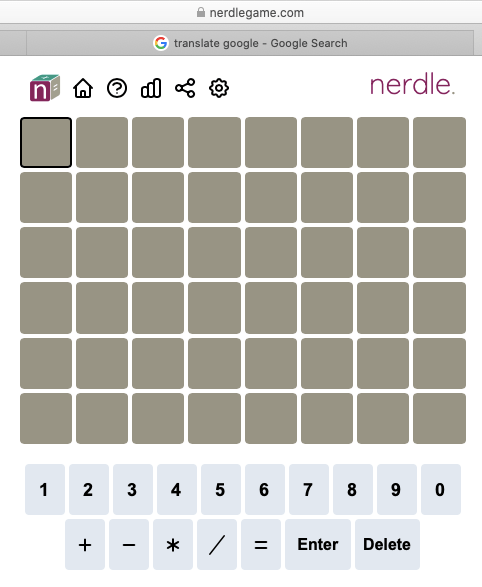
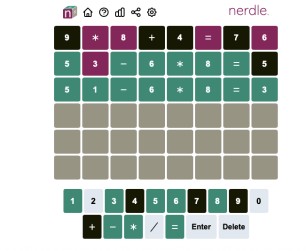
We get six rows of eight cells displayed. Each cell has to contain a digit (1 through to 9) or one of the five operational signs displayed [ + - * / = ]. We then invent an equation that we know is correct and enter this equation as our first guess at the solution. Here we got the equation 9 * 8 + 4 = 76. This is our regular pattern for the first attempt, with the equal sign [ = ] in the sixth position and two other arithmetic signs [ * and + ] in the equation. We also use five different digits in the first equation. The reason why we choose this is simple. We want to see which of our assumptions are correct and we then then, through a process of elimination, guess at the correct solution.
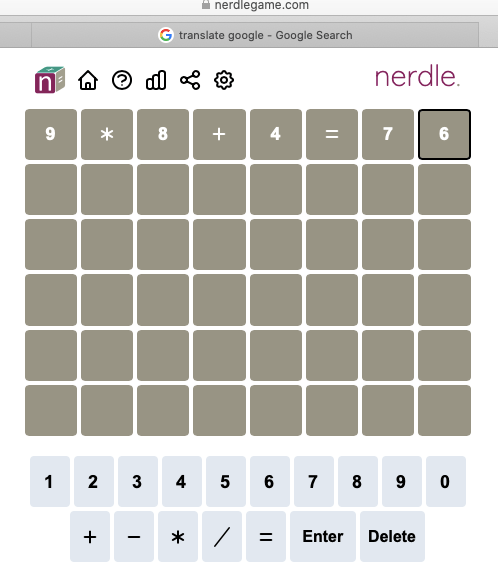
When we enter the equation into the system we get a result as follows:
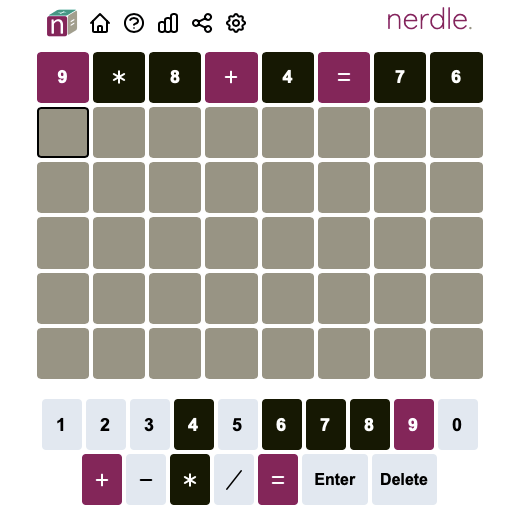
Here, a purple colour represents a correct digit or sign but in the wrong position. The green colour is best, meaning the correct digit or sign in the right position. The black colour represents a failure - that is no such digit or sign in the solution. Here, the digits 4, 6, 7, and 8 are not part of the solution. Neither is the multiplication sign [ * ]. The digit 9, and the other two signs [ + and = ] are in the solution but not in the position we assigned.
The position of the equal sign is easy to guess. It can only be in the fifth, sixth, or the seventh position. Now that the sixth position is not correct our next guess is to place this equal sign in the seventh position and this means that the eighth position must be a single digit (1 through to 9) as the answer to solution equation.
Our next two guesses are shown below:
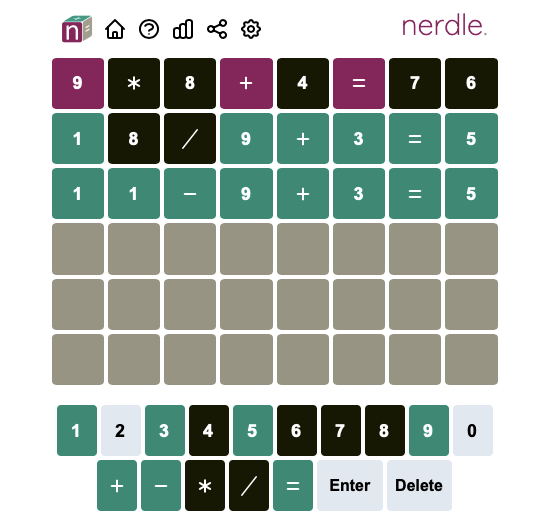
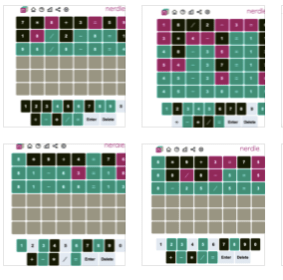
Our second attempt 1 8 / 9 + 3 = 5 shows that there is no division in the solution. Digit 8 is also not in the solution but the rest of the digits 1, 9, 3, and 5 are coloured green - right digits, right positions. Also, the signs [ + and = ] are correct. With these knowledge our next logical guess of 11 - 9 + 3 = 5 proves to be correct, a hundred percent. BINGO!
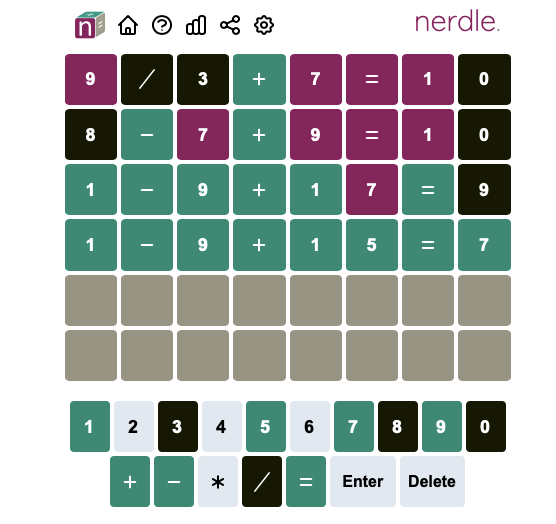
Now, try to explain the logic of the attempts made above. We are only allowed six guesses to win over the computer. If at the sixth attempt, we are unable to guess at the right solution, we have failed in our mission.
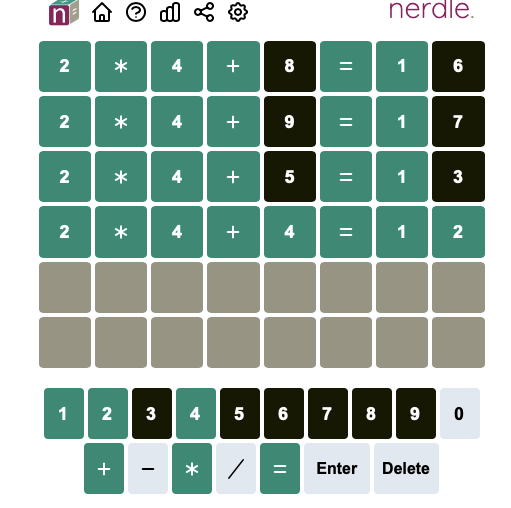
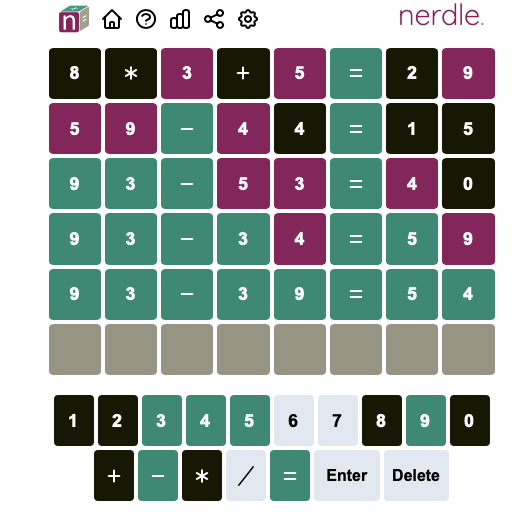
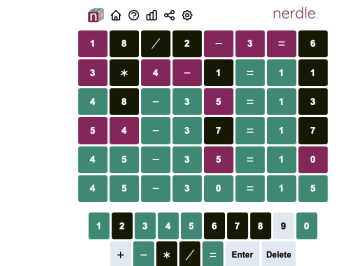
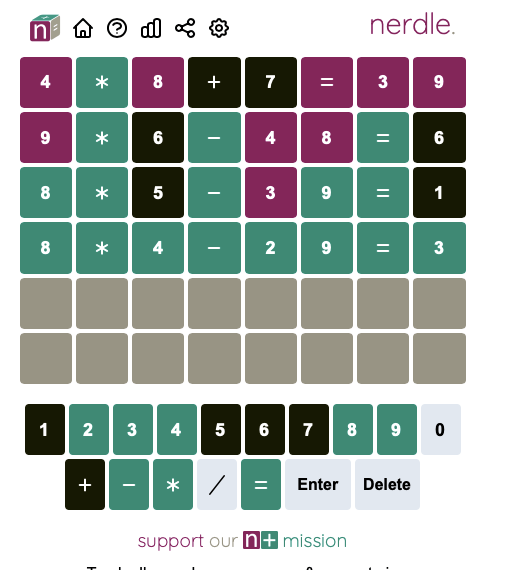
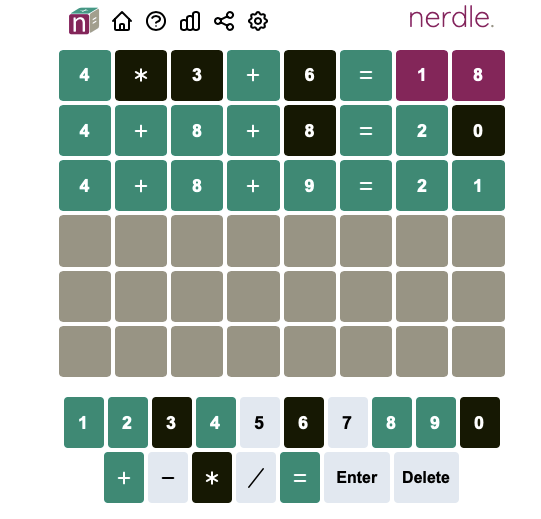
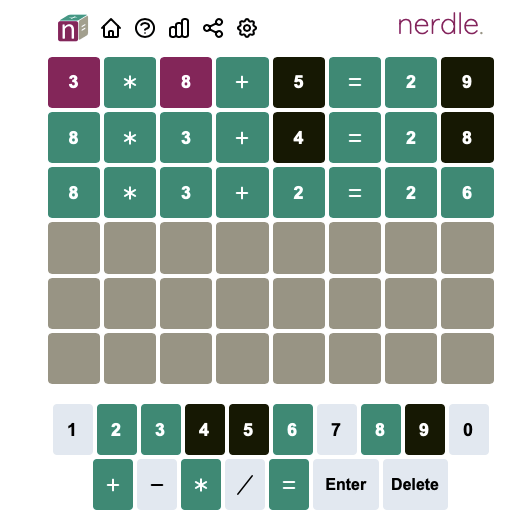
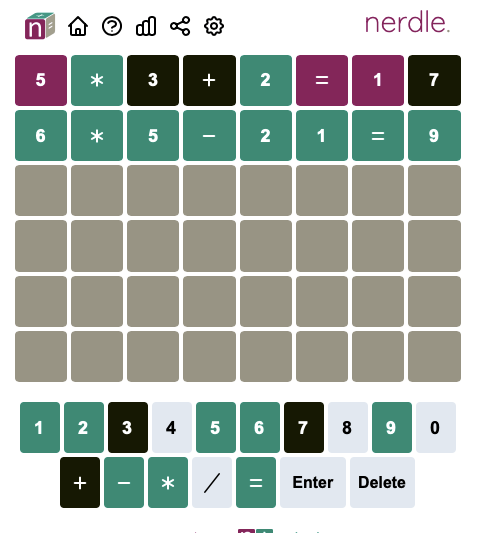
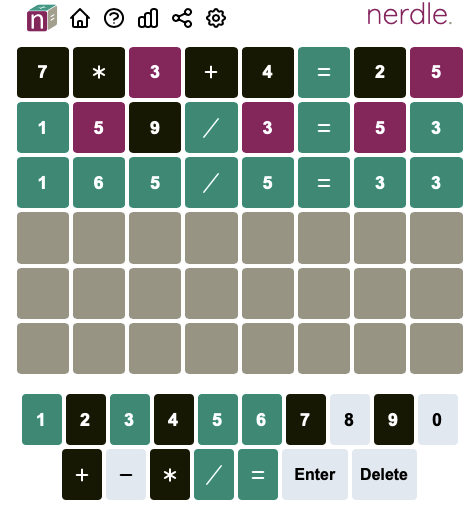
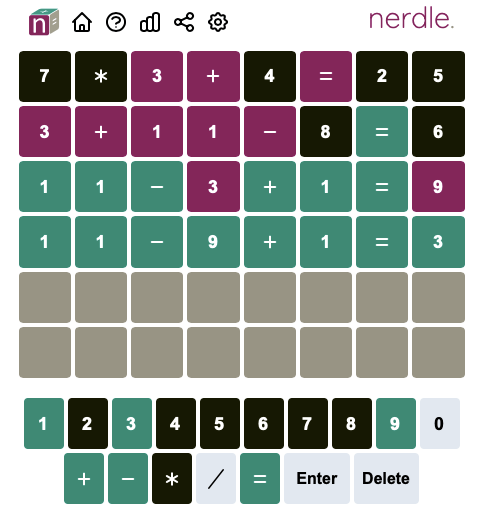
Today we took five attempts to get the right equation. We started with the usual pattern and we have both the multiplication and the addition signs rejected. With the equal sign in the sixth position, there was no possibility to have two operation signs on the left hand side of the equal sign. So we chose to have the minus ( - ) sign next. That proved correct and we proceed on to fine-tune the equation, getting it right only on the fifth attempt.
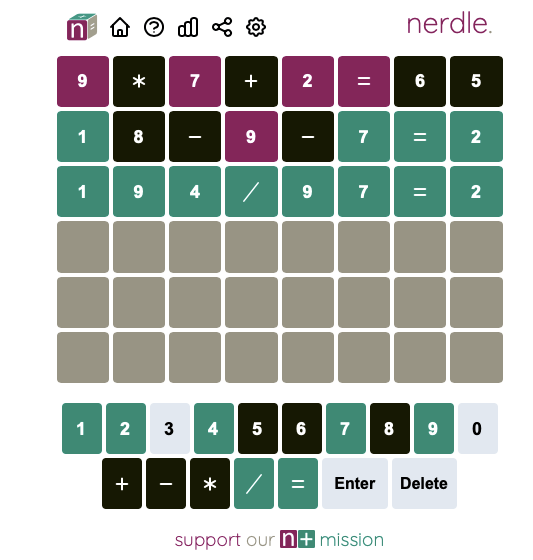
First attempt: 9 * 7 + 2 = 6 5. The signs are not in the solution. The digits 9, 7, and 2 are purple - in the solution but not in the wrong positions. Digits 6 and 5 are not in the solution. The equal sign is in the wrong position.
Second attempt: 1 8 - 9 - 7 = 2. The equal sign is green, right place. The deduction sign is not in the solution. So the only sign present in the solution is therefore the division sign and with the equal sign in the seventh position, the division sign can only be in the fourth position.
Third attempt: 1 9 4 / 9 7 = 2 - correct.
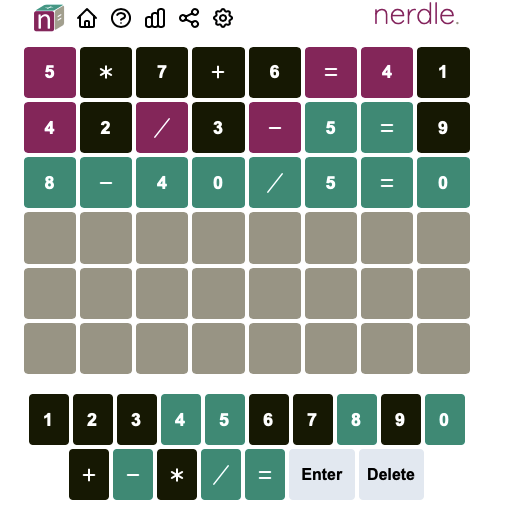
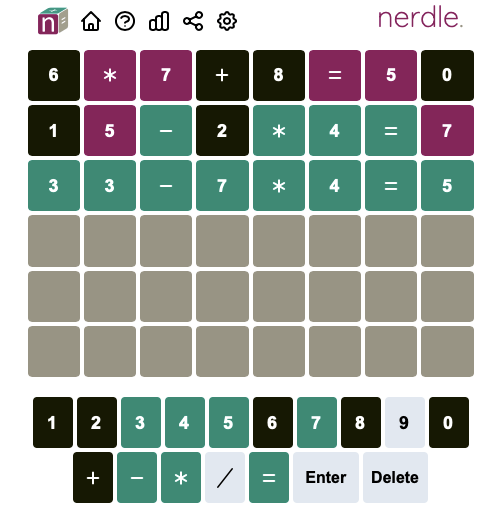
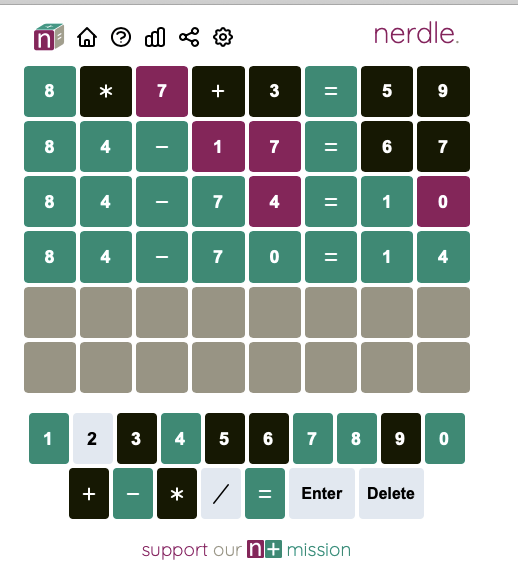
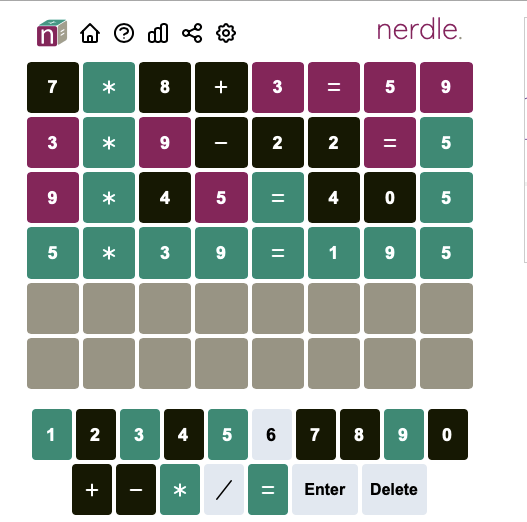
First equation’s aim is to test for the Multiplication and the Addition signs and the placement of the Equal sign. Result: ‘ * ‘ and ‘ + ‘ do not exist in the solution.
Second equation’s aim is to test for the Division and the Deduction signs, and shifting the Equal sign to the seventh position.. The result is that 5 and the equal sign are greens. The other two operational signs ” / ” and ” - ” are in the solution but not in that position.
After some trials and errors on paper, we got the solution of 8 - 40 / 5 = 0.
Come back to this page every day for new another puzzle and see if you can explain the logical steps in our guesses.
 English