Matariki, the Maori New Year 毛利元旦
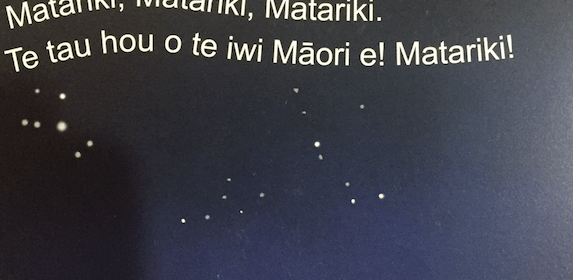
Te tau hou = New Year; o te iwi Maori iwi = of the Maori people! Matariki!
Te tau hou =新年;iwi =毛利族! Matariki!
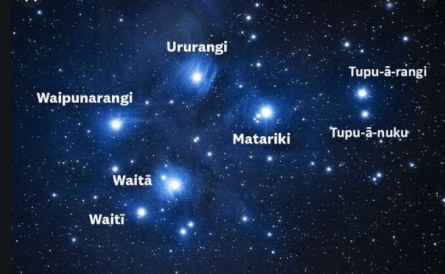
He was talking and drawing stars on the whiteboard. He was talking and writing out the names of the stars on the whiteboard. His back was facing us and therefore we were not able to listen properly. Worse, his colored felt pens, both the blue and the red, ran thin of ink, making it hard for us to read those Maori names of the various stars like Uru-aa-rangi; Waipuna-aa-rangi; Matariki; Waitaa; Waitii; Tupu-aa-rangi and Tupu-aa-nuku.
他在白板上说话和画星星。他正在谈论并在白板上写下星星的名字。他的背对着我们,因此我们无法正确收听。更糟糕的是,他的彩色毡笔(蓝色和红色)墨水稀薄,使我们很难读取Uru-aa-rangi等各种恒星的毛利名字。 Waipuna-aa-rangi; Matariki; Waitaa; Waitii; Tupu-aa-rangi和Tupu-aa-nuku。
Out of politeness, we all said ‘kei pai’ every time he turned to us and asked us with the same two words “kei pai?” over and over again. “Are you Okay?” That was what he was saying. This “kei pai?” could also mean a question like “Do you Understand?” in this context. Of course, we chorused back the reply “ka pai!” meaning “All’s well or Understood”, although I for one, was in complete darkness.
出于礼貌,每次他转向我们并用相同的两个词问“ kei pai”时,我们都会说“ kei pai”。再三,一而再再而三。 “你还好吗?”那是他的意思。这个“ kei pai?”也可能表示类似“您了解吗?”的问题。在这种情况下。当然,我们回覆了“ ka pai!”的回复。意思是“万事如意”,尽管我只说了一个,却完全都不明白。
I have to look into the internet back home by googling ‘Matariki’ before I can fully comprehend what the actively young Maori Language tutor was trying to teach us at our Kura Po family in Unitec’s Maori Language class last Wednesday evening, 19th February 2020. Read the following extract from https://www.twoa.ac.nz/Pages/Te-Iwa-o-Matariki?sc_lang=en
我必须通过谷歌搜索“ Matariki”在家中浏览互联网,然后才能完全理解上个活跃的年轻毛利语言导师试图在2020年2月19日星期三晚上在Unitec毛利语言班的库拉波一家教给我们的知识。以下摘录自https://www.twoa.ac.nz/Pages/Te-Iwa-o-Matariki?sc_lang=en
What is Matariki
Matariki is the Māori name for a cluster of stars that is visible in our night sky at a specific time of the year. In 2020, from 13 to 20 July, Matariki will re-appear in the dawn sky – signaling the start of the Māori New Year.
Matariki是毛利人的名字,意为一年中特定时间在我们的夜空中可见的一簇恒星。 Matariki将在2020年7月13日至20日再次出现在黎明的天空中,这标志着毛利新年的开始。
It is a time to celebrate new life, to remember those who have passed and to plan for the future. And it’s a time to spend with whānau (family) and friends – to enjoy kai (food), waiata (song), tākaro (games) and haka (Maori dance).
现在是庆祝新生活,记住已逝者和为未来做计划的时候。现在是时候与whānau(家人)和朋友一起度过–享受kai(食物),waiata(歌曲),tākaro(游戏)和haka(毛利人舞蹈)。
Our tūpuna (ancestors) would look to Matariki for help with their harvesting. When Matariki disappeared, it was time to preserve crops for the winter season. When it re-appeared in June/July, tūpuna would read the stars to predict the upcoming season – clear and bright stars promised a warm and abundant winter while hazy stars warned of a bleak winter.
我们的 tūpuna(祖先)会向Matariki寻求帮助,帮助他们收获。当Matariki失踪时,是时候为冬季保存农作物了。当6月/ 7月再次出现时,tūpuna会阅读星星来预测即将到来的季节-晴朗明亮的星星预示着温暖而丰富的冬天,而朦胧的星星警告过冬将阴暗。
Because Māori follows the Māori lunar calendar, not the European calendar, the dates for Matariki change every year.
由于毛利人遵循毛利人的阴历而不是欧洲的日历,因此Matariki的日期每年都会更改。
Here are the dates of Matariki for the next five years: 以下是Matariki未来五年的日期:
| Year | Setting | Rise | Period |
|---|---|---|---|
| 2020 | 15 May | 13-16 July | 13-20 July |
| 2021 | 2 June | 2-5 July | 2-10 July |
| 2022 | 23 May | 21-24 June | 21-29 June |
| 2023 | 13 May | 10-13 July | 11-17 July |
| 2024 | 31 May | 29 June-2 July | 29 June-6 July |
Matariki stars are quite symbolic. The future crops are believed to be dependent on the brightness of the stars: the brighter, the better. The name “Matariki” can be decoded in two different ways: either “Mata Riki” meaning “Tiny Eyes”, or “Mata Ariki” meaning “Eyes of God”. Māori name the seven stars of Matariki constellation the Seven Sisters or a Mother and six Daughters. These names refer to the fact that Māori respects their genealogy and gather in a family circle for the New Year celebration in order to reflect on their ancestors who died during that particular year that passed.
Matariki的星星具有象征意义。人们认为,未来的农作物将取决于星星的亮度:越亮越好。名称“ Matariki”可以用两种不同的方式进行解码:“ Mata Riki”表示“小眼睛”,或“ Mata Ariki”表示“上帝的眼睛”。毛利人将Matariki星座的七颗星命名为“七姐妹”或“一位母亲和六个女儿”。这些名字指的是毛利人尊重他们的家谱,并聚集在一个家庭圈子里参加新年庆祝活动,以反映他们过去那一年去世的祖先。
Coming back to the Maori Language lesson at our ‘whanau’ (family) on that evening 19th February, we practiced the ‘mau rakau stances’ after the ‘Matariki’ lesson. We took a wooden pole (about 4 feet or 1.20 meters) each and went out on the grassed outdoor area where we stood with our ‘rakau’ wooden pole on a beginning stance of ‘Whakata’, making sure that there was sufficient space to swing our ‘rakau’ around without hitting another classmate.
回到2月19日晚上在“ whanau”(家庭)的毛利语课程,我们在“ Matariki”课程之后练习了“ mau rakau姿态”。我们各取一根木杆(约4英尺或1.20米),然后在草地茂密的室外区域与“ rakau”木杆站在一起,并以“瓦卡多”的姿态站立,确保有足够的摆动空间我们的“拉考”就没有碰到另一个同学。
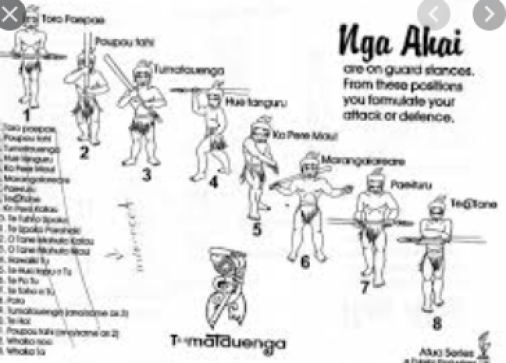
The twenty-four stances have Maori names starting with the Whakata stance https://youtu.be/ioCuaEWIK3I
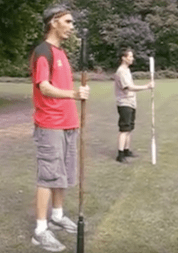
Stance # 1: Whakata.
Stance # 2: Toropaepae
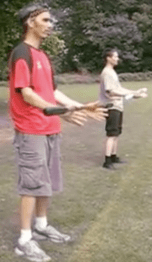
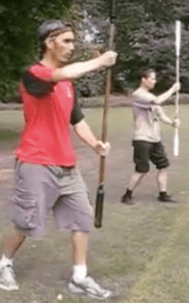
Stance # 3: Paupoutahi
Stance # 4: Tumatautenga
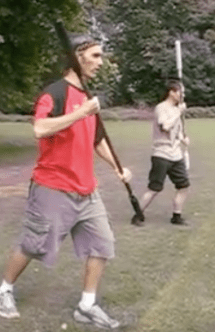
Stance # 5: Hue tanguru
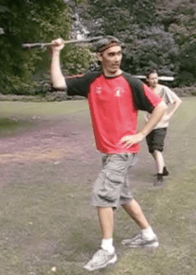
Yes, we stopped at Stance # 5 and repeated these five stances about ten times before we formed a circle and with our rakau in the right hand, we practiced the five action words “Maui” (pass the rakau to the left); “Tika” (pass the rakau to the right); “Roto” (move to the inside of the circle); “Waho” (move to the outside of the circle); and “huruhuri” (turn around on the spot, holding the rakau firmly in the right hand). We practiced these for ten minutes. https://youtu.be/ioCuaEWIK3I
是的,我们在姿态5处停下来,重复了这五种姿态大约十次,然后形成一个圆圈,右手握着 rakau,我们练习了五个动作词 “Maui”(传递rakau到左侧); “Tika”(通过右侧的 rakau); “ Roto”(移到圆圈内); “ Waho”(移到圈子外面);和“ huruhuri”(当场转身,将rakau牢牢握在右手)。我们练习了十分钟.
We went back to the classroom next and learned about the basic sentence construction of a Maori sentence. Unlike the English sentence, a Maori sentence places the time factor first - the tense words representing past, present, present continuous, and future. The second part of the sentence shows the verb or the action. The third part of the sentence is the personal pronoun - I, me, We, our, you, your, he, his, she, her, it. The fourth part of the sentence is the preposition word (or words) to show going forward, to, from, at, and so on. The last fifth part of a sentence shows the goal or the destination where the subject is heading.
接下来,我们回到教室,了解了毛利语句子的基本句子结构。与英语句子不同,毛利语句子将时间因素放在第一位 - 代表过去,现在和将来的时态词。句子的第二部分显示动词或动作。句子的第三部分是人称代词 - 我,我们,您,他,她,它。句子的第四部分是介词(或多个词),用于显示向前,向,从,在,等等。句子的最后第五部分显示主题正在前进的目标或目的地。
We were shown examples.
[Kei te] oma [ahau] ki te [moana]. A sentence that reads “I am going to the beach”. This can be analyzed to [tense ‘kei te’ - present continuous] oma, verb, go so the sentence means ‘going’; [ahau - personal pronoun ‘I’] ki te = moving towards; [moana - ocean, the destination].
Kei te oma ahou ki te _____(a)______ I am running towards the (a) can be moana (ocean or sea); one (beach); whare (house); kura (school); hohipera (hospital); mahi (work).
我正在奔向(a)可以是 moana(海洋或大海); one(海滩);whare(房子); kura (学校); hohipera(医院); mahi(工作)。
I oma ahou ki te moana. I ran towards the ocean or sea. (past tense).
Ka oma ahou ki te moana. I shall be running towards the ocean or sea. (future tense).
Kei te _____(b)____ ahou ki te moana. We can replace (b) with other verbs. For instance, oma = run; taraiwa = drive; hikoi = walk; kawe pahi = taking a bus; paihikara = bicycling.
我们可以将(b)替换为其他动词。例如,oma =走; taraiwa =驱; hikoi =散步; kawe pahi =坐公共汽车; paihikara =骑自行车。
[English] I am cycling to the sea. [Chinese] 我正在骑自行车去海边. [Maori] Kei te paihikara ahou ki te moana.
 English