
Fricatives by Eric Yip 的摩擦音

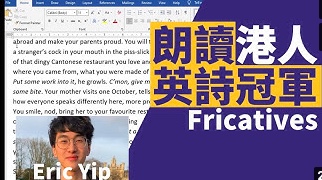
Fricatives - Read by https://youtu.be/Nka8gyxF_0A https://youtu.be/Nka8gyxF_0A.
Simply Voice reads the poem Fricatives by Eric Yip: 19歲劍橋大學經濟系香港學生Eric Yip獲頒英國國家詩詞比賽冠軍,為該獎項最年輕得主。 “As somebody who now resides in England, shares the same Hong Kong root, did Economy as his first degree and does phonetics work for living, I just love this piece so much that I felt I have to give the recitation of this poem a go. I hope I did not ruin it.” Let us listen to the reading of the poem (full text below), before we do out comments.
To speak English properly, Mrs Lee said, you must learn
the difference between three and free. Three men
escaped from Alcatraz in a rubber raft and drowned
on their way to Angel Island. Hear the difference? Try
this: you fought your way into existence. Better. Look
at this picture. Fresh yellow grains beaten
till their seeds spill. That’s threshing. That’s
submission. You must learn to submit
before you can learn. You must be given
a voice before you can speak. Nobody wants to listen
to a spectacled boy with a Hong Kong accent.
You will have to leave this city, these dark furrows
stuffed full with ancestral bones. Know
that death is thorough. You will speak of bruised bodies
skinnier than yours, force the pen past batons
and blood, call it fresh material for writing. Now
they’re paying attention. You’re lucky enough
to care about how the tongue moves, the seven types
of fricatives, the articulatory function of teeth
sans survival. You will receive a good education
abroad and make your parents proud. You will take
a stranger’s cock in your mouth in the piss-slick stall
of that dingy Cantonese restaurant you love and taste
where you came from, what you were made of all along.
Put some work into it, he growls. C ’mon, give me
some bite. Your mother visits one October, tells you
how everyone speaks differently here, more proper.
You smile, nod, bring her to your favourite restaurant,
order dim sum in English. They’re releasing
the students arrested five years ago. Just a tad more
soy sauce please, thank you. The television replays
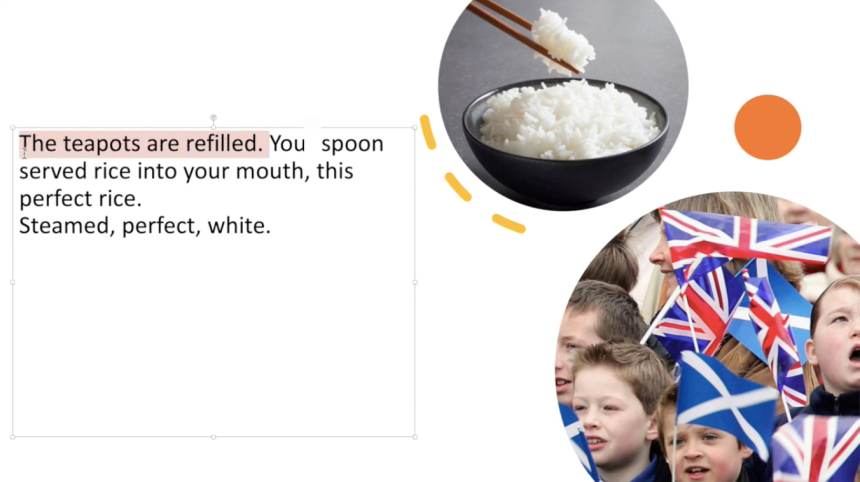
yesterday on repeat. The teapots are refilled. You spoon
served rice into your mouth, this perfect rice.
Steamed, perfect, white.
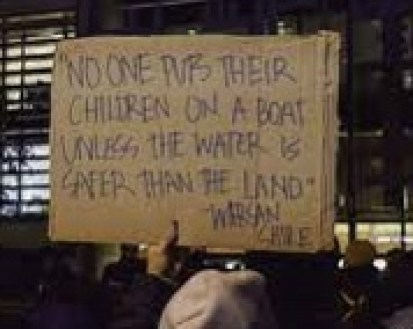

十九岁的Eric Yip,来自香港,在英国学习经济学,当之无愧地赢得了今年的全国诗歌大赛。他是该奖项最年轻的获得者。卫报 https://www.theguardian.com/books/2022/mar/31/national-poetry-competition-youngest-ever-winner-eric-yip-fricatives 表达了这样的观点:“......他的诗摩擦音,(其中)玩弄关于语言的想法,以(也)评论殖民主义、种族、移民、归属感和离开家的内疚感。”
The three judges, Fiona Benson, David Constantine and Rachel Long, read all the entries anonymously, and judged Eric Yip’s ‘Fricatives’, as the best poem this year.
三位评委 Fiona Benson、David Constantine 和 Rachel Long 匿名阅读了所有参赛作品,并将 Eric Yip 的《摩擦音》评为今年最佳诗歌。
The poem ‘Fricatives’ can be translated into the Chinese language as follow:
《摩擦音》这首诗可以翻译成中文如下: 说好英语,我们的李老师说,你必须学会"three"三 和 "free" 免费 的区别。三个男人 乘坐橡皮筏从恶魔岛逃脱并淹死 在前往天使岛的路上。听到区别了吗?尝试 这:你为生存而奋斗。更好的。看 在这张照片上。鲜黄粒打散 直到他们的种子溢出。那就是脱粒。那是 提交。你必须学会提交 在你可以学习之前。必须给你 说话之前的声音。没人愿意听 对一个带着香港口音的戴眼镜的男孩。 你将不得不离开这座城市,这些黑暗的沟壑 塞满了祖先的骨头。知道 死亡是彻底的。你会谈到伤痕累累的身体 比你的瘦,把笔逼过去 和血,称其为写作的新鲜材料。现在 他们正在关注。你够幸运 关心舌头如何移动,七种类型 摩擦音,牙齿的发音功能 没有生存。 你会接受良好的教育 在国外,让你的父母感到自豪。你会拿 一个陌生人的阴茎在你的嘴里,在光滑的小摊上 你喜欢和品尝的那家肮脏的粤菜馆 你来自哪里,你一直是由什么组成的。 投入一些工作,他咆哮道。来吧,给我 咬一口。你妈妈在 10 月份来访,告诉你 在这里,每个人的说法都不一样,更恰当。 你微笑,点头,带她去你最喜欢的餐厅, 用英语点了点心。他们正在释放 五年前被捕的学生。再多一点 请酱油,谢谢。电视重播 昨天重复。茶壶重新装满。你勺子 把米饭送进嘴里,完美的米饭。 蒸熟,完美,白色。
What is Fricative? Fricative, in phonetics is a consonant sound, like English ” f “ or ” v ” , produced by bringing the mouth into position to block the passage of the airstream, but not making complete closure, so that air moving through the mouth generates audible friction. Fricatives (also sometimes called “spirants”) can be produced with the same positions of the vocal organs as stops; bilabial, labiodental, dental, alveolar, palatal velar, and uvular consonants. In addition to the ” f “ and ” v ” sounds, examples of fricatives in English are ” s “ as in “sitter,” and ” z “ as in “zebra,” and the two ” th ” sounds as in “think” and “this.”
什么是摩擦音?擦音,在语音学中是一种辅音,如英语的“ f ”或“ v ”,通过将嘴巴放在适当的位置以阻止气流通过,但没有完全闭合,因此空气通过嘴巴会产生可听见的摩擦. 擦音(有时也称为“旋音”)可以在发声器官的位置与塞音相同的位置产生; bilabial、labiodental、dental、alveolar、palatal velar 和 uvular 辅音。 除了“ f ”和“ v ”音之外,英语中擦音的例子还有“sitter”中的“ s ” 和 “zebra” 中的 “ z ”,以及 “think” 中的两个 “ th ” 音 和 "this".
On the surface, this poem speaks about the difficulty of Hong Kong students in the learning of spoken English language as they are unable to overcome the pronunciation of fricative consonants. As we analyse the poem a little deeper, however, we find that to those who had lived in Hong Kong during the umbrella protest and during the recent anti-government violence, this poem does have another subtle meaning to it as explained hereunder. https://www.bbc.com/news/world-asia-china-49317695
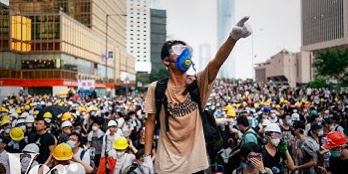
从表面上看,这首诗讲述了香港学生在学习英语口语方面的困难,因为他们无法克服摩擦辅音的发音。然而,当我们更深入地分析这首诗时,我们发现对于那些在伞状抗议期间和最近的反政府暴力期间住在香港的人来说,这首诗确实有另一个微妙的含义,如下所述。 https://www.bbc.com/news/world-asia-china-49317695
Let us read the poem again in seven parts and slowly disgust the meaning of the written words.
Part 1:
To speak English properly, Mrs Lee said, you must learn the difference between three and free. Three men escaped from Alcatraz in a rubber raft and drowned on their way to Angel Island. Hear the difference? Try this: you fought your way into existence. Better.
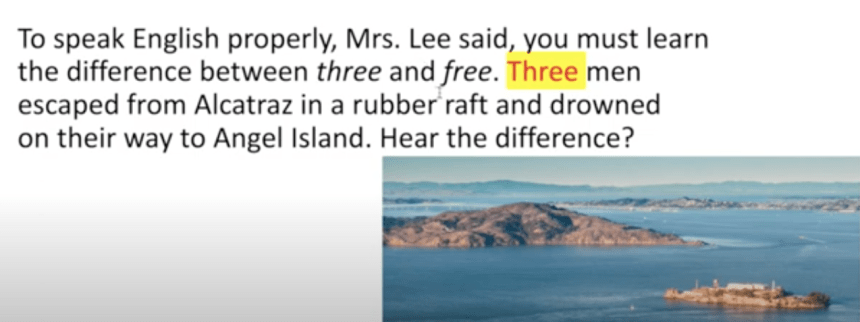
Mrs. Lee here refers to the author’s English teacher, perhaps from Hong Kong. She says that to speak English properly we need to learn fricatives - the difference of saying or reading “three” and “free”. “Three” is not “free”. Then there are words like the ‘F’ in ‘Fresh’, the ‘th’ in ‘threshing’, and the ‘s’s’ in ‘submission’, ‘seeds’, ‘spill’, ‘speak’, and ‘spectacled’ in the next part of the poem.
The second sentence becomes more informative when we consider that the author Eric Yip comes from Hong Kong in recent troubled times of unrests and protests. “Three men (if not pronounced correctly becomes Free men” escaped from Alcatraz in a rubble raft and drowned on their way to Angel Island.” What do the two locations - Alcatraz and Angel Island represent? In the photograph above, Alcatraz is the small prison colony of an island on the right hand side while Angle Island is the bigger island on the left. History has it that Angel Island was an immigration station on the west coast of America in San Francisco Bay, California, and the main purpose of that facility was for the deportation of Chinese and Japanese illegal immigrants duringthe period 1900 - 1940 under the Chinese Exclusion Act of 1882. Alcatraz, the prison colony is located only two kilometres away to the north of St. Francisco.
If we think a little deeper, Alcatraz is subtly meant to represent the Hong Kong, the ‘oppressive’ island and Angle Island is meant to represent the United Kingdom where freedom of speech is allowed. Hence the connection of this sentence with sound and proper speech of English fricatives. The drowning of the “Free men” is meant to mean the many protestors whose lives were destroyed during that troubled period when police forces brutally attacked the protestors.
“Hear the difference?” has a double meaning. Do we hear the difference between “Three” and “Free”? Do we hear the difference between the treatment of people in Alcatraz and in Angle Island?



这里的李老师指的是作者的英语老师,可能来自香港。她说,要正确地说英语,我们需要学习摩擦音——说或读“three”和“free”的区别。 “three” 和 “free”读的音调是不一样的。然后是 “Fresh” 中的 “F”、“threshing” 中的 “th” 以及 “submission” 中的 “s”、 “seeds”、 “spill”、 “speak” 和 “spectacled” 等词在诗的下一部分。
当我们考虑到作者 Eric Yip 在最近动荡和抗议的动荡时期来自香港时,第二句话变得更加丰富。 “三个人(如果发音不正确,就会成为自由人”)乘坐瓦砾筏逃离恶魔岛,在前往天使岛的途中溺水身亡。“ 恶魔岛和天使岛这两个地点代表什么?在上面的照片中,恶魔岛是小的右边是一个岛屿的监狱殖民地,而安格尔岛是左边较大的岛屿。历史记载天使岛是美国西海岸加利福尼亚州旧金山湾的移民站,其主要目的是根据 1882 年的排华法案,该设施用于在 1900 年至 1940 年期间驱逐中国和日本的非法移民。恶魔岛,监狱集中地位于圣弗朗西斯科以北仅两公里处。
如果我们想得更深一点,恶魔岛是巧妙地代表香港,“压迫”岛和安格尔岛是为了代表允许言论自由的英国。因此,这句话与英语擦音的正确发音有关。 “自由人” 的溺水是指在警察部队残酷袭击抗议者的动荡时期,许多抗议者的生命被摧毁。
“听到区别了吗?” 有双重含义。我们听到 “three” 和 “free” 的区别了吗?我们听到恶魔岛和安格尔岛对人们的待遇有什么不同吗?
Part 2: Try this: you fought your way into existence. Better. Look at this picture. Fresh yellow grains beaten till their seeds spill. That’s threshing. That’s submission. You must learn to submit before you can learn. You must be given a voice before you can speak. Nobody wants to listen to a spectacled boy with a Hong Kong accent.
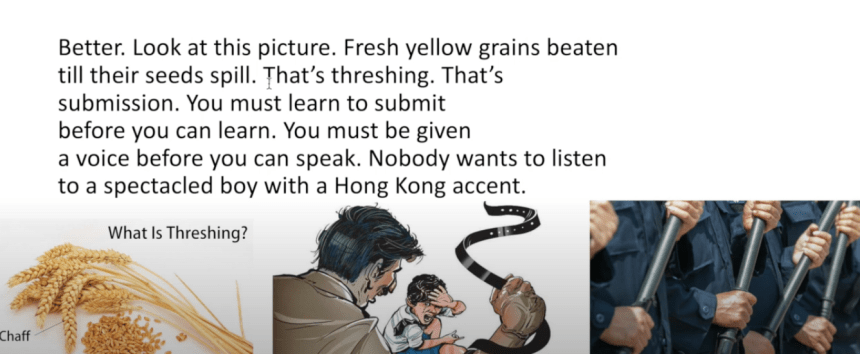
The second part of the poem moves us into first of three scenarios - that of fresh yellow grains beaten until their seeds spill. “Try this,” the author says, “you fought your way into existence.” Here the author expresses an opinion that learning English is symbolised as a battle - we need to work hard to be successful (onto existence). He uses the rice chaff as an example. To get the white rice, we need to beat the chaff hard to get the white grain of rice. “That’s threshing,” two ‘th’s’ placed together to let us practice vocalising the difference between the two. In another hidden meaning is that the word “threshing” rhymes with “thrashing” and then the sentence makes another meaning - that people have to be beaten to submission - like the police in Hong Kong beating the protestors with their batons. Or, a father wiping his son into obedience.
“Nobody want to listen to a spectacled boy with a Hong Kong accent,” must be talking about himself before he acquires the British accent and be able to vocalised the fricatives properly.

这首诗的第二部分将我们带入了三个场景中的第一个——新鲜的黄色谷物被打到种子溢出。 “试试这个,”作者说,“你为生存而奋斗。”在这里作者表达了一种观点,学习英语象征着一场战斗——我们需要努力工作才能成功(生存)。他以稻壳为例。为了得到白米饭,我们需要用力敲碎糠,才能得到白米饭。 “那是脱粒,”两个 'th' 放在一起让我们练习发声两者之间的差异。另一个隐藏的含义是,“打谷”一词与“鞭打”押韵,然后这句话又产生了另一种含义——人们必须被殴打至屈服——就像香港警察用警棍殴打抗议者一样。或者,一位父亲让他的儿子服从。
“没有人愿意听一个戴眼镜的香港口音的男孩”,这肯定是在他学会英国口音并能够正确地发出擦音之前谈论自己。
Part 3: You will have to leave this city, these dark furrows stuffed full with ancestral bones. Know that death is thorough. You will speak of bruised bodies skinnier than yours, force the pen past batons and blood, call it fresh material for writing. Now they’re paying attention.
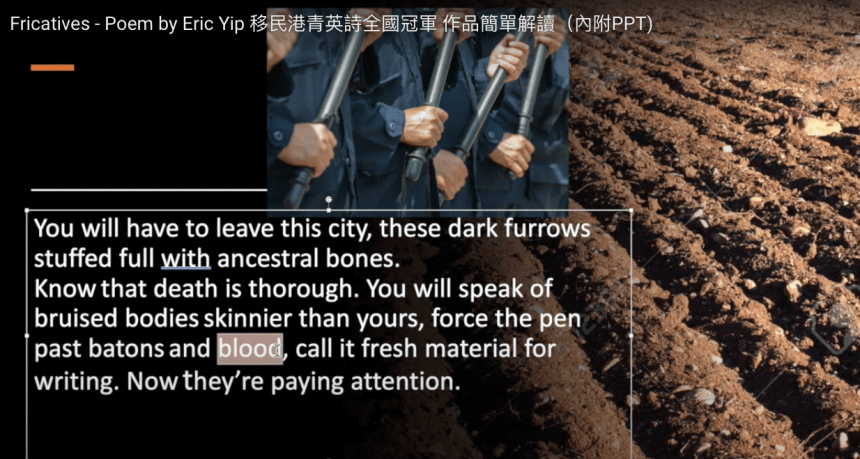
The third part of this interesting poem does contain more words fricatives - the “f’s” and “v’s”, the two types of “th’s”, and the “s’s”. The less obvious side of this part is the reference to the “furrows stuffed full with ancestral bones,” the “death that is thorough”, and the “braised bodies skinner than yours,” all of these are images from the protest movements in Hong Kong city. These images ‘force the pen past batons and blood, call it fresh materials for writing,” referring to the reasons for the author’s writing this poem, which makes the world to “pay attention.” https://youtu.be/j_72SlHIqDE
这首有趣的诗的第三部分确实包含更多的词擦音——“f's”和“v's”,“th's”和“s's”的两种类型。这部分不太明显的一面是提到了“满是祖骨的沟”,“死得彻底”,“红烧的身体比你的还皮”,这些都是香港抗议运动的形象。孔城。这些意象“逼笔过警棍和鲜血,称其为写作的新鲜材料”,指的是作者写这首诗的原因,令世人“关注”。
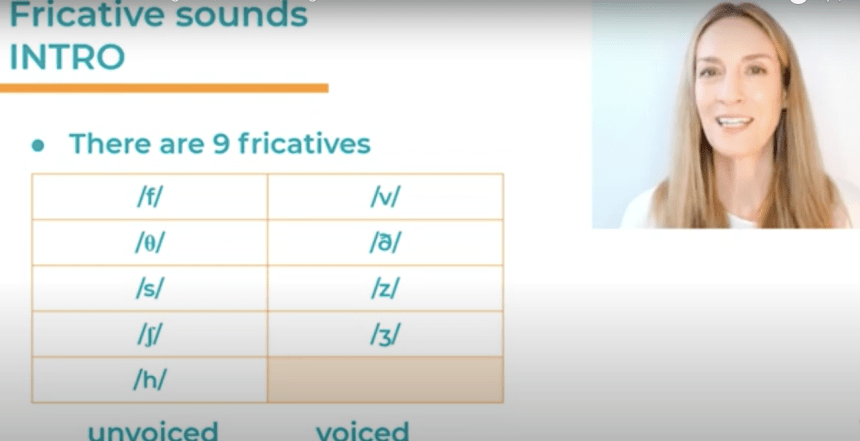
Part 4: If you are lucky enough to go to the right schooling and learned how the tongue moves to get the seven (actually, nine) fricatives correct, you may still not survive in a English speaking world. Why? You have made your parents proud of you if you receive a good education abroad, (like in the United Kingdom) but you still may not survive in this English speaking world. Why?
第 4 部分:如果你有幸上到了正确的学校并学会了舌头如何移动以使七个(实际上是九个)擦音正确,那么你可能仍然无法在英语世界中生存。为什么?如果你在国外接受良好的教育(比如在英国),你会让你的父母为你感到骄傲,但你可能仍然无法在这个英语世界中生存。为什么?
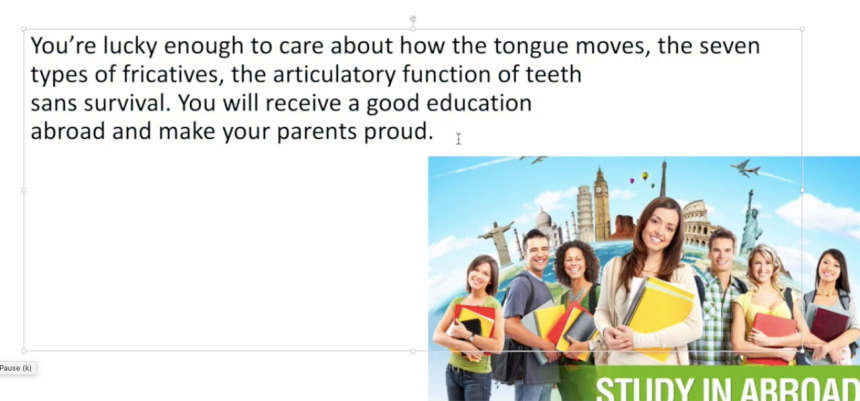
Part 4: You’re lucky enough to care about how the tongue moves, the seven types of fricatives, the articulatory function of teeth sans survival. You will receive a good education abroad and make your parents proud.
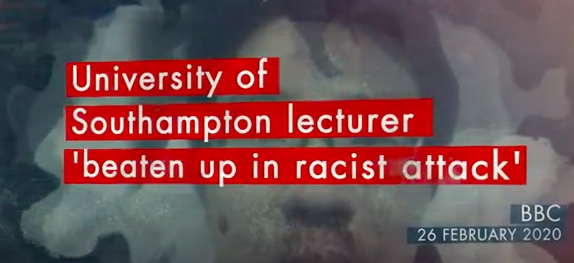
Part 5: This part of the poem can be classified as offensive to some readers, but the author uses such crude and possibly course language to illustrate the racial prejudice that many Hong Kong Chinese have experienced, in the toilet of a Hong Kong styled Cantonese restaurant. Whether such events are happening in Hong Kong or in the United Kingdom are not disclosed. In the context of the article, is this part relevant to the subject matter of fricatives? Or, can it be that such racial prejudice occurs when a Hong Kong migrant to the United Kingdom cannot get his fricatives properly pronounced?
第五部分:这首诗的这部分可以归类为冒犯某些读者,但作者用这种粗俗甚至可能是粗俗的语言来说明许多香港华人在一家港式粤菜餐厅的厕所里所经历的种族偏见.此类事件是否发生在香港或英国尚未披露。在文章的上下文中,这部分是否与摩擦音的主题有关?或者,当一个香港人移居英国时,他的擦音无法正确发音时,会不会出现这种种族偏见?
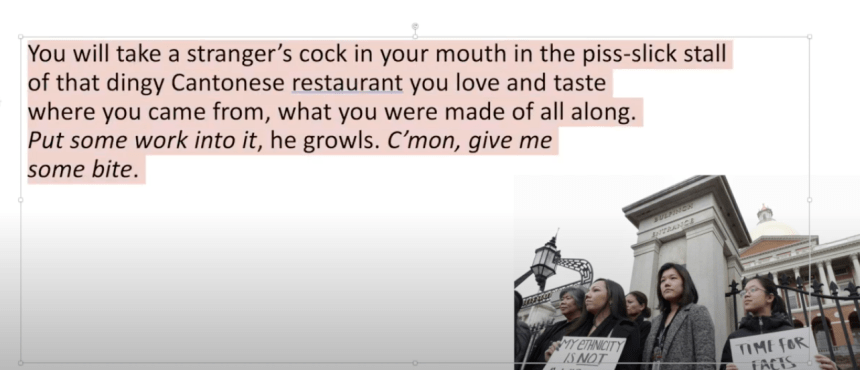
Part 5: You will take a stranger’s cock in your mouth in the piss-slick stall of that dingy Cantonese restaurant you love and taste where you came from, what you were made of all along. Put some work into it, he growls. C’mon, give me. some bite.
Part 6: Your mother visits one October, tells you how everyone speaks differently here, more proper. You smile, nod, bring her to your favourite restaurant, order dim sum in English.
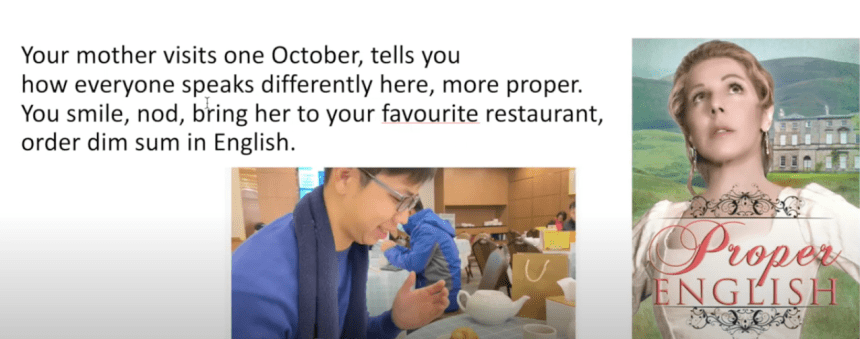
Part 6: The author’s mother visited the author one October and she observed that the people around her in the United Kingdom were speaking English differently, but all of them spoke proper English, implying that they had all mastered the fricatives. The author agreed and took her to a Cantonese “dim sum” restaurant and he ordered the dishes in proper English, (must be to his mother’s delight.)
第六部分:作者的母亲在 10 月份拜访了作者,她观察到她周围的英国人说英语的方式不同,但他们都说得一口流利的英语,暗示他们都掌握了擦音。笔者同意并带她去了一家粤菜“点心”餐厅。他用正确的英语点菜,(一定让他妈妈很高兴。)
Part 7: During the “dim sum” meal, the television was replaying the release of the Hong Kong protests, detained some five years back. The poem ends with a reflection of Hong Kong lifestyle, the consuming of rice, perfect white rice. This scene can be tied back to the earlier Part 2 when white rice can only be derived after the wheat has been properly threshed. In other words, the author has suffered all the humiliations and now he has the reward of perfect white rice.
第 7 部分:在“点心”餐中,电视正在重播大约五年前被拘留的香港抗议活动的释放情况。这首诗的结尾反映了香港的生活方式,吃米饭,完美的白米饭。这个场景可以追溯到前面的第 2 部分,当时只有在小麦经过适当脱粒后才能获得白米。换句话说,作者受尽了所有的屈辱,现在他得到了完美白米的奖励。
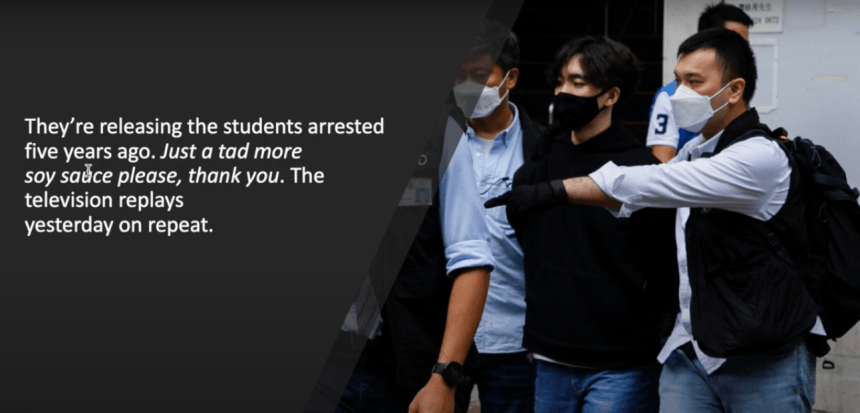
Part 7: They’re releasing the students arrested five years ago. Just a tad more. soy sauce please, thank you. The television replays yesterday on repeat. The teapots are refilled. You spoon served rice into your mouth, this perfect rice. Steamed, perfect, white.
Fricatives - Poem by Eric Yip 移民港青英詩全國冠軍 作品簡單解讀(內附PPT). https://youtu.be/0o_g9lN2uVA
想用BNO移民又覺得自己英文不夠好?你必須要學會的100個超常見英國生字,涵蓋衣食住行。移民英國準備充足,融入社會,滿足生活所需,識朋友無難度! *十分抱歉,技術不足,部份影片聲畫未能同步,請見諒。
Want to use your BNO (British Nationals Overseas) to immigrate to the United Kingdom but feel that your English is not good enough? Here are a hundred super common British words you must learn, covering basic necessities of life. To immigrate to the United Kingdom, we have to be fully prepared to integrate into the UK society, to meet the needs of life, and to make friends without difficulty! *Sorry for some parts of this video where the sound tracks are not properly synchronised.
Fricatives - Poem by Eric Yip 移民港青英詩全國冠軍 作品簡單解讀(內附PPT) by Fung Fung Classroom https://youtu.be/0o_g9lN2uVA. #fricatives#ericyip#nationalpoetrycompetition#poem#HongKong#poet#pronunication#literature#colonialism#race#migration#diaspora

 English