
Nerdle Logic - NERDLE 的逻辑

Have you done Today’s Needle yet? If this is the first time you come across the word “Nerdle” then please watch the following video from YouTube first. https://youtu.be/elQunLQM_7k
你完成今天的 Nerdle 了吗?如果这是您第一次遇到“Nerdle”一词,请先观看 YouTube 上的以下视频。https://youtu.be/elQunLQM_7k (in English)
https://youtu.be/gHrZo7MGKPU (in Cantonese)
https://youtu.be/h4sh0SH-we4 (no dialogue)
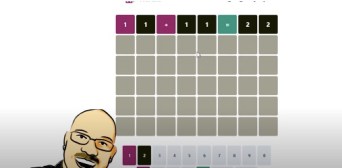
There are eight boxes in each row (an attempt to get at the right equation). The eight boxes are to be filled with numbers 0, 1, 2, 3, 4, 5, 6, 7, 8, and 9 and four mathematical signs +. -. * (multiply) and / for divide, and an = sign. The equal sign has to be on the right side of the equation (just a number of one, two or three digits) that allows only one answer for the equation. We have six rows or attempts to get the right equation. The example shown on the right here is a clear example of a wasted attempt as there are only two digits there, 1 and 2. The right first attempt should be one where as many different digits as possible are to be packed in, thus the elimination process can work to our advantage in getting a solution.
每行有八个框(试图得到正确的等式)。八个方框将用数字 0、1、2、3、4、5、6、7、8 和 9 和四个数学符号 +。 -。 *(乘)和 / 用于除,还有一个 = 符号。等号必须在等式的右侧(只有一位、两位或三位数字),这使得等式只允许一个答案。我们有六行或尝试得到正确的方程。此处右侧显示的示例是浪费尝试的明显示例,因为那里只有两个数字,1 和 2。正确的第一次尝试应该是尽可能多的不同数字的尝试,因此消除过程可以帮助我们获得解决方案。
I normally use equations like 2 * 7 + 4 = 18 as my first attempt - five different numbers, two operations signs, one equal sign. The answer to this attempt should provide me with the clues I need for my second attempt. Look at the following examples of my attempts in the past few days.
我通常使用像 2 * 7 + 4 = 18 这样的等式作为我的第一次尝试——五个不同的数字、两个运算符号、一个等号。这次尝试的答案应该为我提供第二次尝试所需的线索。看看下面我这几天尝试的例子。
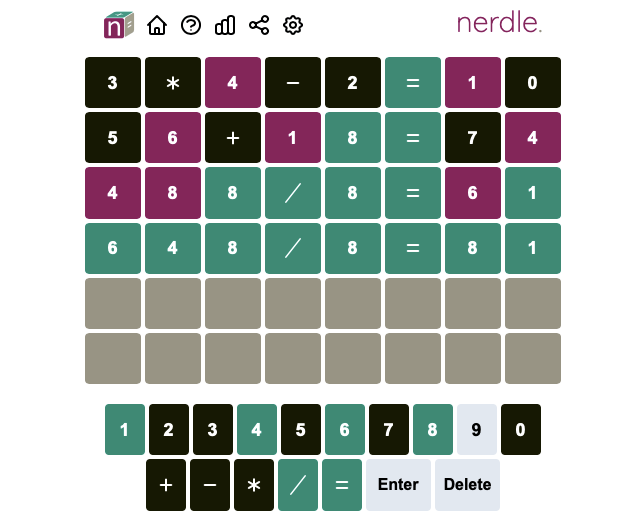
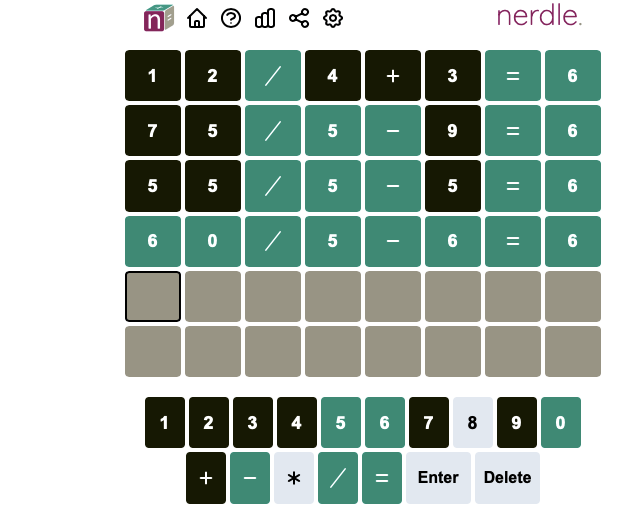
The first line here uses 0, 1, 2, 3 and 4 as the five digits and and operation sign multiply ” * ” and minus ” - “.
The second line tests for one of the other two operation sign, plus ” + ” and this is not correct. There is therefore only one divide sign ” / ” in the solution. The second line also tests for the relevance of other digits 5, 6, 7, and 8.
Line three rearranges all the known digits and with the divide ” / ” we form an equation that is almost correct.
Line four produces the correct answer.
这里的第一行使用 0、1、2、3 和 4 作为五位数字和运算符号乘以“*”和减号“-”。 第二行测试其他两个操作符号之一,加“+”,发现不正确。因此,解中只有除号“/”。第二行还测试其他数字 5、6、7 和 8 的相关性。 三行重新排列所有已知数字,并用除“/”形成一个几乎正确的方程。 第四行产生正确答案。
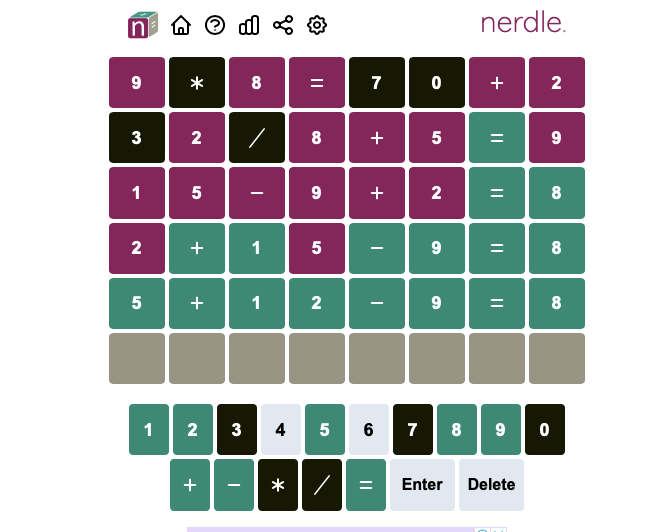
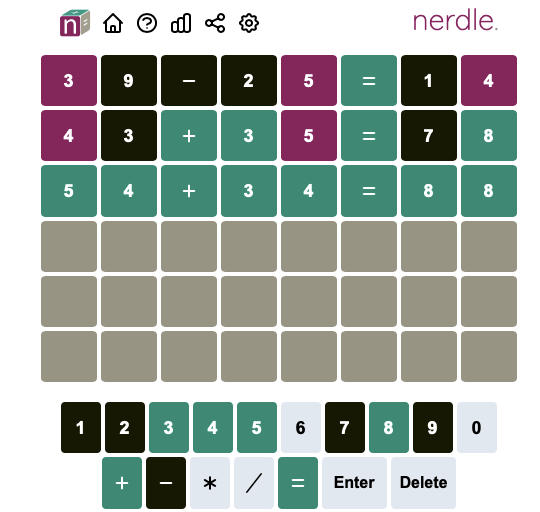
上面显示的下一个示例遵循与上一个示例相同的原理。我们有 2、7、8 和 9 作为数字以及乘号和加号。第二行引入了数字 3 和 5。等号的修改位置还有除号。第三行和第四行用已知数字和两个相关符号加 + 和减 - 表示。第五行是正确的解决方案。
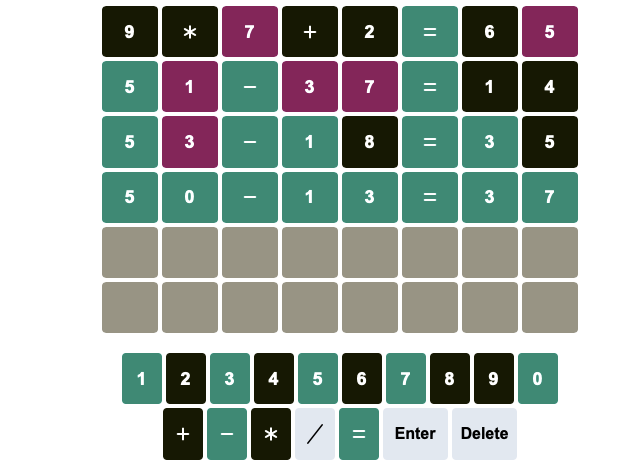
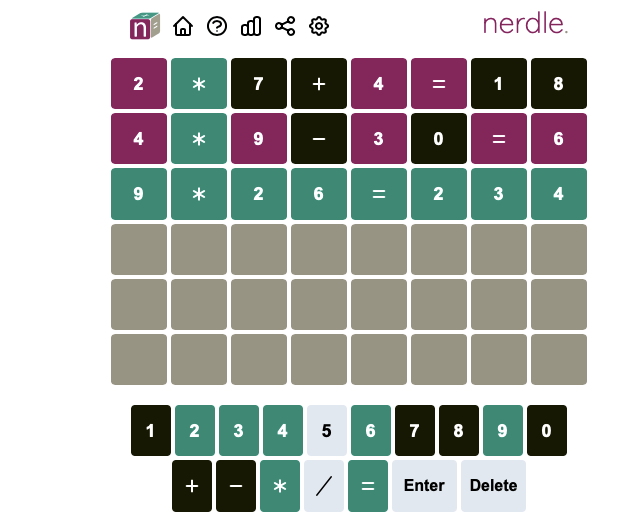
The following further examples highlight the same logical method used to get the solutions within the six attempts.
以下进一步的示例突出了用于在六次尝试中获得解决方案的相同逻辑方法。
 English