
Designing Word Puzzles 设计字谜
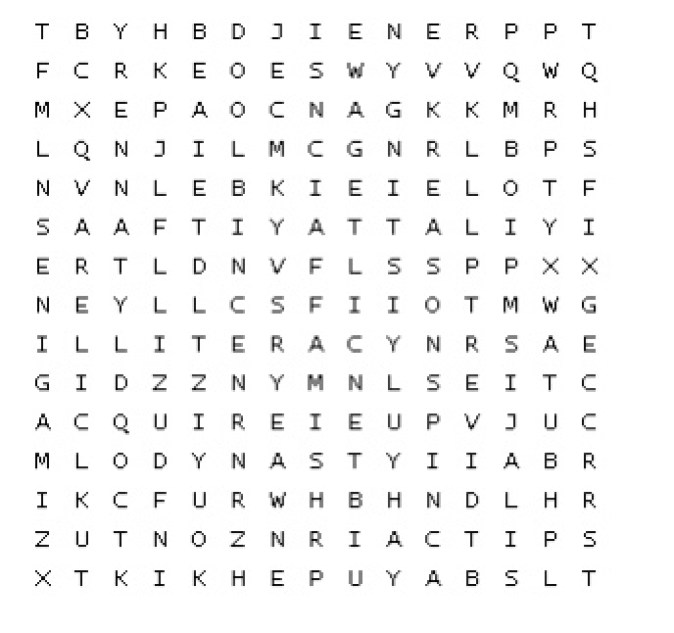
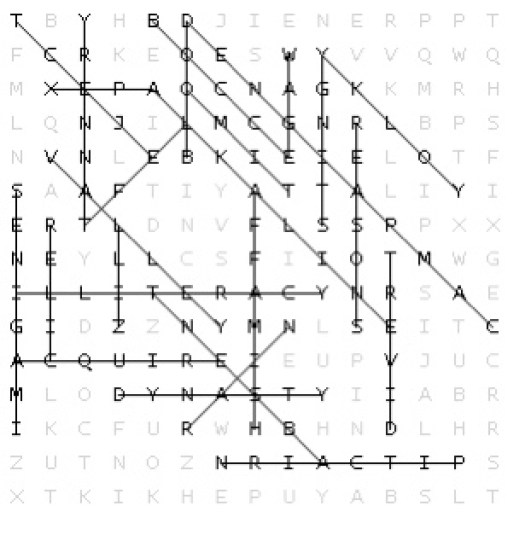
Search the following twenty five words inside the 15 columns x 15 rows grid above. Note that the words can go in any direction - horizontally, vertically, or diagonally, from top to bottom or from bottom up. Words can share letters as they cross over each other.
在上面的 15 列 x 15 行网格中搜索以下 25 个单词。请注意,单词可以在任何方向 - 水平,垂直或对角线,从上到下或自下而上。当它们相互交叉时,单词可以共享字母。
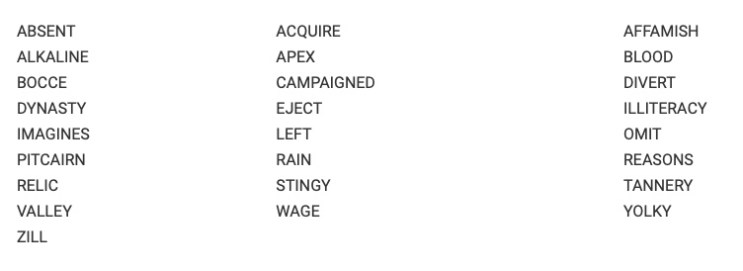
These twenty-five words are words that we have created in a crossword puzzle that is given later on in this article. For the moment, let us learn how to create a Word Search Game just like the one shown by using the computer program found at the website: https://puzzlemaker.discoveryeducation.com/word-search
这 25 个单词是我们在本文后面给出的填字游戏中创建的单词。现在,让我们学习如何使用网站上的计算机程序创建一个单词搜索游戏,就像显示的那样:https://puzzlemaker.discoveryeducation.com/word-search
(1) Open up the website. (2) Step 1: Enter a title for the puzzle to be created. (3) Step 2: Enter the size of the puzzle grid. We usually find that a 15 columns x 15 rows grid is good for between twenty to thirty words. (4) Step 3: Select the option ‘share letters as much as possible’. (5) Step 4: Select ‘image’ as our output. (6) Step 5: Select ‘use all upper cases’ option. (7) Step 6: Enter the words that are to be searched - we have twenty-five words here. (8) Select ‘show instructions’. and finally (9) Step 8: Leave this alone - the computer program will check all the words automatically to leave out offensive words. (10) Click on ‘Create My Puzzle’ and the puzzle is created.
(1)打开网站。 (2) 第 1 步:输入要创建的拼图的标题。 (3) 第二步:输入拼图网格的大小。我们通常发现 15 列 x 15 行的网格适合 20 到 30 个单词。 (4) 第 3 步:选择“尽可能多地分享信件”选项。 (5) 第 4 步:选择“图像”作为我们的输出。 (6) 第 5 步:选择“使用所有大写字母”选项。 (7) 第 6 步:输入要搜索的单词——我们这里有 25 个单词。 (8) 选择“显示说明”。最后 (9) 第 8 步:不要管它——计算机程序会自动检查所有单词以排除冒犯性的单词。 (10) 点击“创建我的拼图”,拼图就创建好了。
The solution to this puzzle can be found at the end of this article.
这个难题的解决方案可以在本文末尾找到。
We now turn to creating a Word Code Puzzle for the school going teenagers. We start off with an empty Word Code grid modelled from one of Simon Shuker’s Word Cracker grids in a 13 columns by 13 rows square. We name the columns in alphabets from ‘a’ right through to ‘m’ and the rows in numbers from ‘1’ right through to ’13’. These references make it easy for us to name a particular cell, say a 8 or f 13. The important aspect of designing a Word Code Puzzle is to ensure that all the twenty-six alphabets are represented an incorporated into the design.
The chosen grid, with coloured cells not meant to be filled, is shown below:
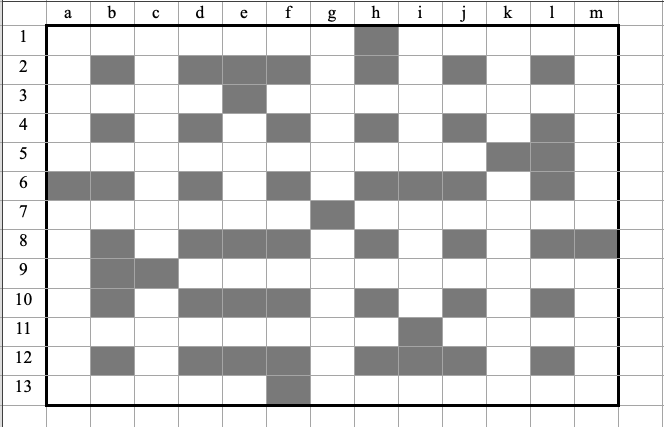
我们现在转向为上学的青少年创建一个字代码拼图。我们从一个空的 Word Code 网格开始,该网格是由 Simon Shuker 的 Word Cracker 网格之一建模而成的 13 列 x 13 行正方形。我们将字母中的列命名为从“a”到“m”,将行命名为从“1”到“13”。这些参考资料使我们可以很容易地命名一个特定的单元格,比如 8 或 f 13。设计字代码拼图的重要方面是确保所有 26 个字母都被表示并融入到设计中。上面显示了选定的网格,其中彩色单元格不应该被填充:
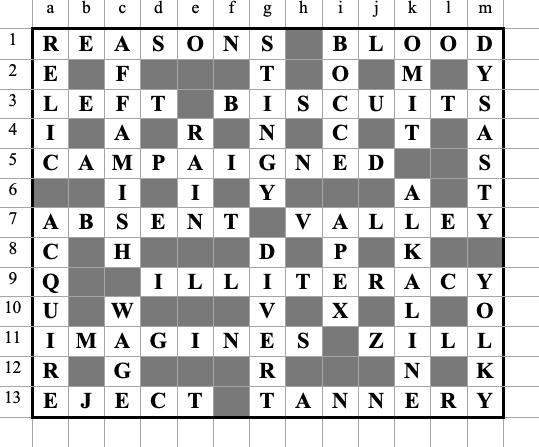
It is always good to start designing the solution to the puzzle first and to search for words that can start both across a row as well as down a column. We therefore start with cell a1 across (7 letters) and a1 down (5 letters). We choose REASONS for a1 across and RELIC for a1 down. These are words that a secondary student will know.
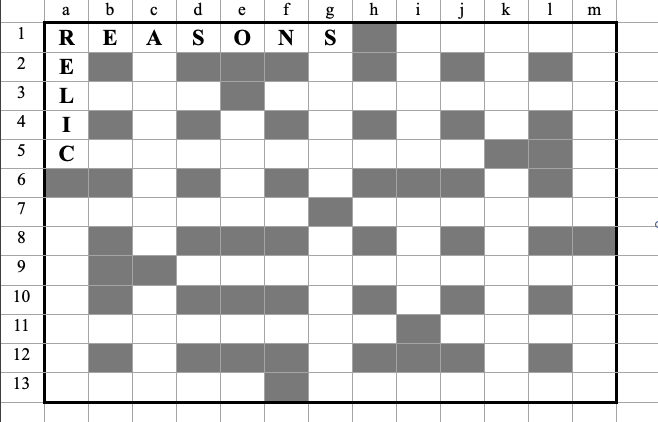
首先开始设计谜题的解决方案并搜索可以从一行开始也可以从一列开始的单词总是好的。因此,我们从单元格 a1 开始(7 个字母)和 a1 向下(5 个字母)。我们为 a1 选择了原因,为 a1 选择了 RELIC。这些是中学生会知道的单词。现在我们需要寻找前两个单词已经打开网格的单词,例如 a3 处的 4 个字母单词、a5 处的 10 个字母单词、c1 down 处的 8 个字母单词和 6 个字母的单词g1 下的单词。我们选词:LEFT; CAMPAIGNED; AFFAMISH;和 STINGY.
Now we need to look for words where the previous two words have opened up the grid, like the 4-lettered word at a3 across, the 10-lettered word at a5 across, the 8-lettered word at c1 down and the 6-lettered word at g1 down. We choose the words: LEFT; CAMPAIGNED; AFFAMISH; and STINGY respectively.
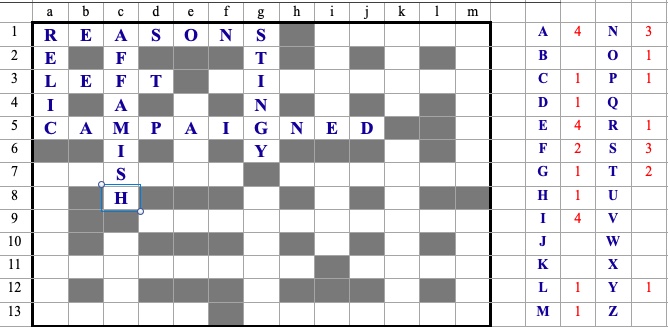
It is useful at every stage to keep a number count as to the alphabets used so far and the counts can be found on the right hand side of the photograph above.
The next two words that we use are PITCAIRN (cell f3 across) and ABSENT (cell a7 across).
在每个阶段对目前使用的字母进行计数是很有用的,计数可以在上图的右侧找到。 接下来我们使用的两个词是 PITCAIRN(跨单元格 f3)和 ABSENT(跨单元格 a7)。
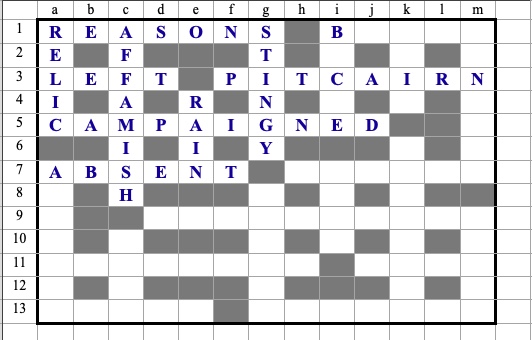
Continuing along with the searches, we find the words BOCCA for i1 down; OMIT for l1 down; and DYNASTY for m1 down. We also find BLOOD in i1 across.
继续搜索,我们找到 i1 down 的单词 BOCCA;省略 l1 向下;和 DYNASTY 用于 m1 向下。我们还在 i1 中找到 BLOOD。
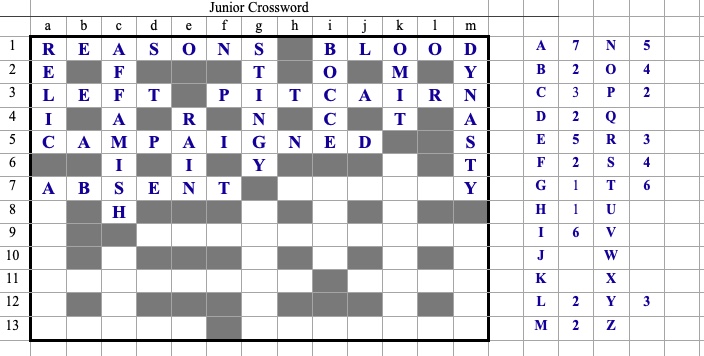
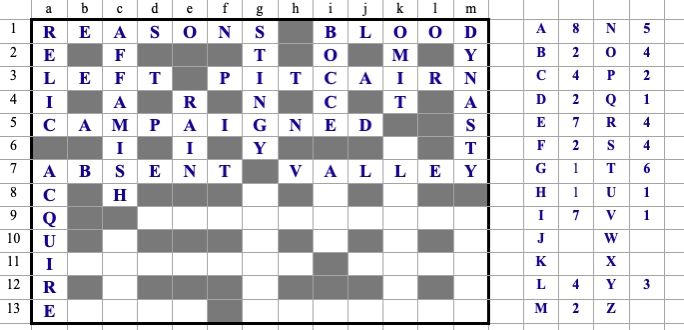
接下来,我们为 a7 down 选择单词 ACQUIRE,因为我们需要在网格中使用字母“Q”,并且 Q 通常后跟字母“U”。所以字母“U”也被覆盖了。同样,我们为单元格 h7 选择字母“V”,以使 h7 跨过单词 VALLEY。现在字代码只缺少以下字母“J”; 'K'; 'W'; 'X';和“Z”。 对于字母“X”,我们选择将单词 APEX 插入到单元格 i7 下方的空间中,对于字母“J”,我们将其放置在单元格 a13 与单词 EJECT。
For the letter ‘X’ we have selected the word APEX to be slotted into the space at cell i7 down and for the letter ‘J’ we place this at cell a13 across with the word EJECT.
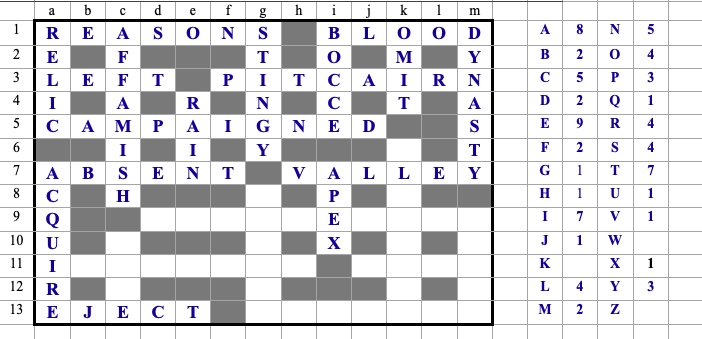
For the letter ‘W’ we place this at cell c10 down - WAGE. We now have two long words to search at a11 across (8 letters) and at d9 (10 letters). We find IMAGINES for a11 and ILLITERACY for d9.
对于字母“W”,我们将其放在单元格 c10 下方 - WAGE。我们现在有两个长词要在 a11(8 个字母)和 d9(10 个字母)处搜索。我们发现 a11 的 IMAGINES 和 d9 的 ILLITERACY。
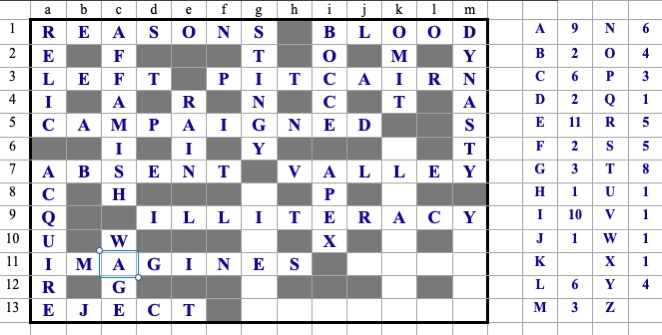
We find a place for ‘K’ in YOLKY at cell m9 down.
我们在 YOLKY 的 m9 向下单元格中找到了“K”的位置。
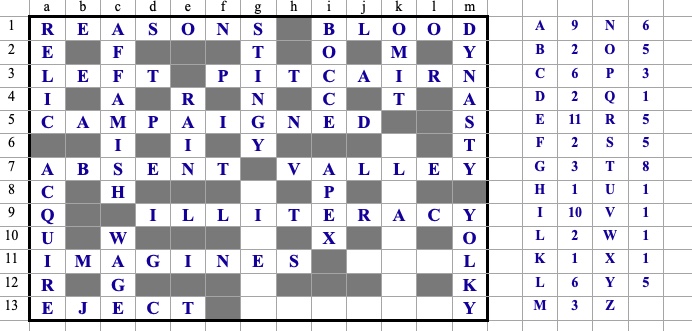
The last four words are difficult to get pinned down and matching in all directions. And, we need a place for the final letter ‘Z’. We got ALKALINE for cell k6 down; DIVERT for cell g8 down; TANNERY for g13 across; and finally, ZILL for j11 across.
我们在 YOLKY 的 m9 向下单元格中找到了“K”的位置。最后四个词很难在各个方向上确定和匹配。而且,我们需要为最后一个字母“Z”留一个位置。我们得到了AKALINE k6; 单元格g8向下的DIVERT; g13 的 TANNERY;最后,ZILL for j11 。
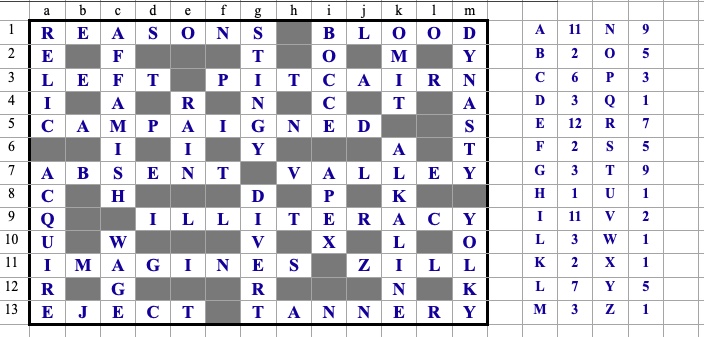
The above grid becomes the solution to the Word Code Puzzle. We just have to place numbers to replace the alphabets to get the Word Code Puzzle for our teenager to solve. The Puzzle now looks like this:
上面的网格成为字代码谜题的解决方案。我们只需要放置数字来替换字母,就可以为我们的青少年解决字代码谜题。拼图现在看起来像这样:
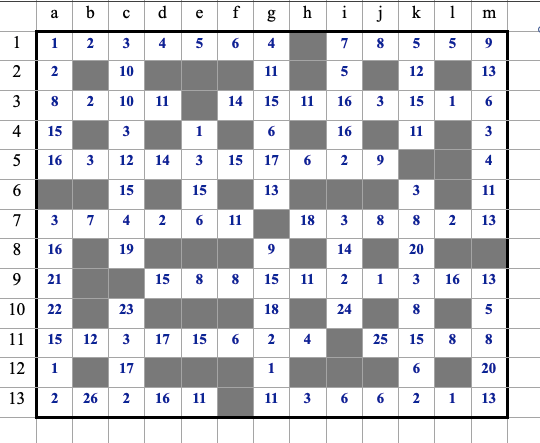
The solution is already shown but can also be summarised as follows:
解决方案已经显示,但也可以总结如下:
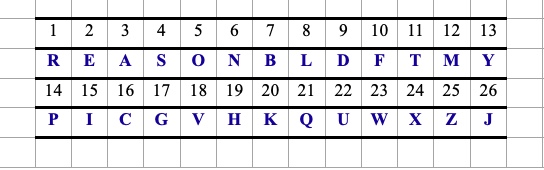
This same grid is also the solution for Crossword Puzzle. We now have to hide all alphabets and have to provide hints or clues for each of the twenty five words now uncovered, to form the Crossword Puzzle.
同样的网格也是填字游戏的解决方案。我们现在必须隐藏所有字母,并且必须为现在发现的 25 个单词中的每一个提供提示或线索,以形成填字游戏。
The Cross Word Puzzle looks as follows:
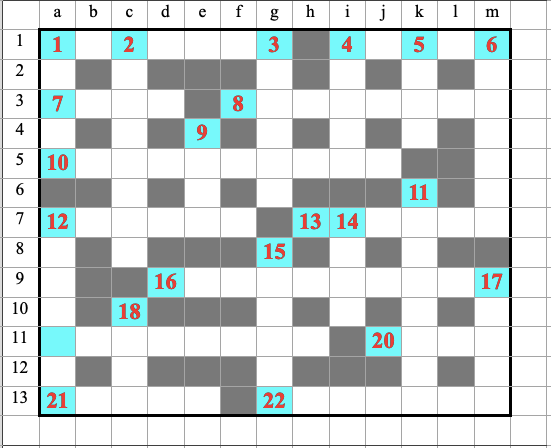
The Clues for the Crossword Puzzle are as follows:
ACROSS:
| 1 Explanations when answering to a ‘Why?’ question. (7) |
| 4 The red fluid running inside our body. (5) |
| 7 Leave behind unintentionally. (4) |
| 8 A Nation of four islands in the Pacific Ocean with a population of only 50 people. (8) |
| 10 Had run, stood, or competed for a political office or position. (10) |
| 12 Go away or leave. (6) |
| 13 A deep and long depression in the surface of the land that usually contains a river. (6) |
| 16 An inability to read. (10) |
| 19 Forms a mental image of something that is not present or is not the case. (8) |
| 20 One of a pair of small metallic cymbals worn on the thumb and middle finger to keep the rhythm with a belly dance. (4) |
| 21 Put out or expel from a place. (5) |
| 22 Workplace where skins and hides are tanned. (7) |
DOWN:
| 1 An antique item from past historic days of many years ago. (5) |
| 2 To afflict with hunger. (8) |
| 3 Unwilling to spend money. (6) |
| 4 A type of Italian bowling game, played on a long narrow dirt court. (5) |
| 5 Leave out or leave undone. (4) |
| 6 A sequence of leaders from the same family in ancient China. (7) |
| 9 Water falling in drops from vapour condensed in the atmosphere. (4) |
| 11 Relating to or containing an alkali. (8) |
| 12 Gain something through one’s own efforts. (7) |
| 14 The highest point of a hill. (4) |
| 15 Turn aside or turn turn away from. (5) |
| 17 Like the yellow part of an egg. (5) |
| 18 A salary or remuneration. (4) |
CROSSWORD SOLUTION, similar to WORD CODE SOLUTION:
WORD SEARCH SOLUTION:
 English