
Is this Sudoku really HARD? 这个数独真的很难吗?
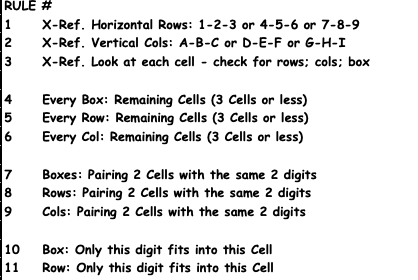
Let us revise the fifteen Francis’ Rules for Sudoku.
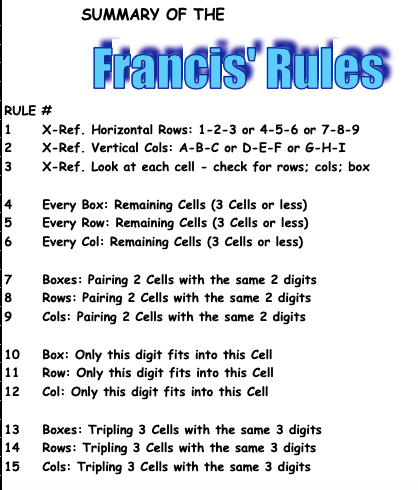
The first three rules are called “Cross Referencing Rules”. We take a good look at each Row, each Column, and each Cell to see whether there are two similar digits in two cells of a Row (Rule # 1) or of a Column (Rule # 2). Then examine each cell in the light of the digits in the surrounding Rows, Columns, or Squares to see if there is just one number that can fit into a particular cell (Rule # 3).
The second three rules are collectively called “Remaining Cell”. When in a Box, there are less than four uncovered digits, those digits can be easily found in a mental process of elimination of numbers (Rule # 4). In a similar manner, the remaining Cell can be applied to a Row (Rule # 5) or to a Column (Rule # 6).
The next three rules concern the pairing of two cells in a Square each with the possibility of two similar digits (Rule # 7), or in a Row (Rule # 8) or in a Column (Rule # 9). If a pair is found, then the digits for the other cells in that square, or that row, or that column can easily be found.
Rules # 10, # 11, and # 12 deal with situations when only one digit is possible in a particular cell found on a box (Rule # 11), or in a Row (Rule # 12) or in a Column (Rule # 12).
The last three rules are collectively called “Tripling three cells”. These rules apply in the same manner as in Rules # 7, # 8, and # 9, except that this time, there are three possible numbers in three cells of a Square (Rule # 13), or of a Row (Rule # 14) or of a Column (Rule # 15).
NOTE: The Chinese version of this article will be posted in another later webpage. 请注意:本文的中文版将在稍后的另一个网页中发布。
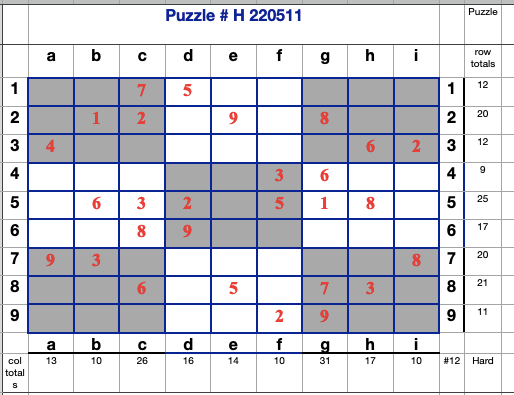
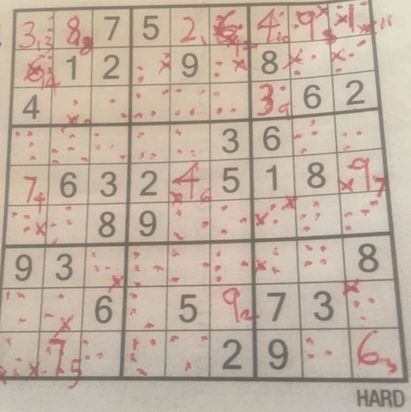
The Hard Sudoku today from the NZ Herald is shown above.
We start solving this Sudoku Challenge by applying Francis’ Cross Referencing Rules. Looking at Rows # 1, # 2, and # 3, we find cell c2 = i2 = 2 = f9. Therefore cell e1 is equal to 2. [Francis’ Rule # 1]. Step # 1.
Likewise, in Rows # 7, # 8, and #9, we have cell a7 = cell g9 = 9 and is also the digit for cell d6. So cell f8 = 9. [Francis’ Rule # 1]. Step # 2.
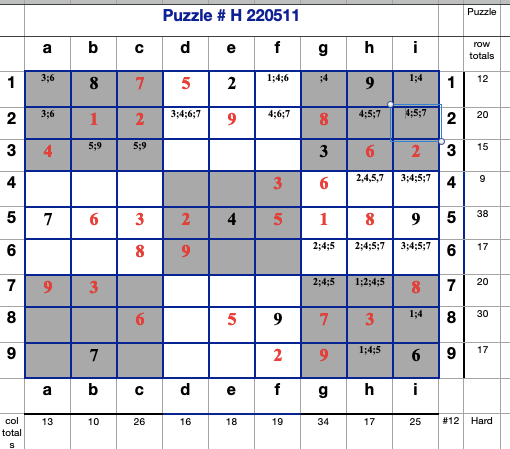
We look now at Francis’ Rule # 2 now, looking at the columns, three at a time. In Columns g, h, and I, we find that cell g4 = cell h3 = 6 and is also equal to the same digit for cell c8. Therefore cell i9 is equal to 6 as well. [Francis’ Rule # 2]. Step # 3.
At Row # 5 now, we find three cells without digits and the missing digits are 4, 7, and 9. We then notice that in Column a, cell a3 = 4 and cell a7 = 9. Therefore the digit for cell a5 must be the remaining digit 7. [Francis’ Rule # 5]. Step # 4. Sticking on to Row # 5, we can easily deduce that cell e5 = 4 (Step # 5) because cell e2 = 9; and the remaining cell i5 = 9. [Francis’ Rule # 5]. Step # 6.
Then for Columns a, b, and c, we have cell a5 = cell c1 = 7 = cell g8. So, cell b9 = 7. [Francis’ Rule # 2]. Step # 7. Likewise, for Columns g, h, and I, we can logically deduce that cell h1 = 9 (Step # 8) because cell g9 = cell i5 = 9 = cell e2. [Francis’ Rule # 2].
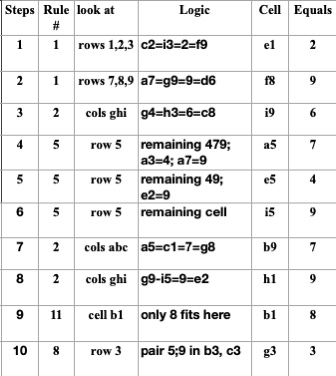
At Box # 1, we look at the cells surrounding cell b1, and if we run our finger to every exposed digits in the relevant columns and rows, we find that cell b1 = 8. [Francis’ Rule # 11]. Step # 9.
If we now pair 5 and 9 for cells b3 and c3 in Row # 3, we have cell g3 = 3. [Francis’ Rule # 8]. Step # 10.
At Box # 3, we look at the cells surrounding cell g1, we find that only digit 4 fits into this cell. So cell g1 = 4. [Francis’ Rule # 10]. Step # 11. Repeat this again for cell i1 on Box # 3, we get cell i1 = 1. [Francis’ Rule # 10]. Step # 12.
In Row # 1, we have two remaining cells for digits 3 and 6. But, cell f4 = 3, therefore cell f1 must equal to 6. [Francis’ Rule # 5]. Step # 13. The last remaining cell in Row # 1, cell a1 must equal to 3. [Francis’ Rule 5]. Step # 14.
In Box # 1, we can pair 5,9 in cells b3 and c3, and with cell a1 =3, we know that cell a2 = 6. [Francis’ Rule # 7]. Step # 15.
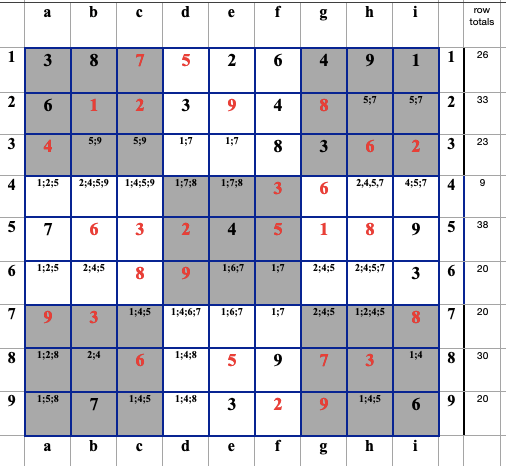
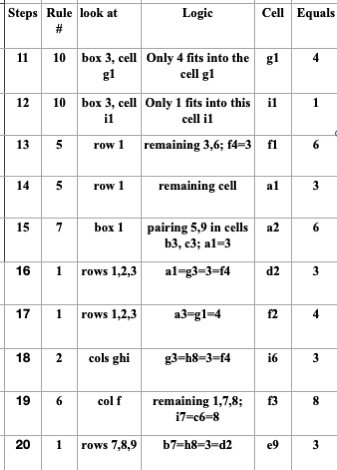
We turn our attention now to rows # 1, 2, and 3 and notice that cell a1 = cell g3 = 3 = cell f4. Using Francis’ Rule # 1, therefore, cell d2 = 3. Step # 16. Similarly and also looking at rows # 1, 2, and 3, we have cell a3 = cell g1 = 4. Therefore cell f2 = 4. [Francis’ Rule # 1]. Steps # 17.
We now look at Columns g, h, and I. Here, cell g3 = cell h8 = 3 = cell f4. So, cell i6 = 3. [Francis Rule # 2]. Step # 18. For Column f, there are three remaining cells now for digits 1, 7, and 8. Since cell i7 = cell c6 = 8, cell f3 = 8. [Francis’ Rule # 6]. Step # 19.
For Rows # 7, # 8, # 9, we have cell b7 = cell h8 = 3 = cell d2. Therefore cell e9 = 3. [Francis’ Rule # 1]. Step # 20.
Similarly, for Rows # 4, # 5, and # 6, we find that cell b5 = cell g4 = 6 = cell f1. So logically cell e6 = 6. [Francis’ Rule # 1] Step # 21.
At Columns d, e, and f, we have cell f1 = cell e6 = 6 =cell c8 = cell i9. The digit for cell d7 is 6. [Francis’ Rule # 2]. Step # 22.
For Column e, there are three digits remaining 1, 7, and 8 for three vacant cells. Cell f3 = 8 and is equal with cell i3. Therefore cell e4 = 8. [Francis’ Rule 6]. Step # 23.
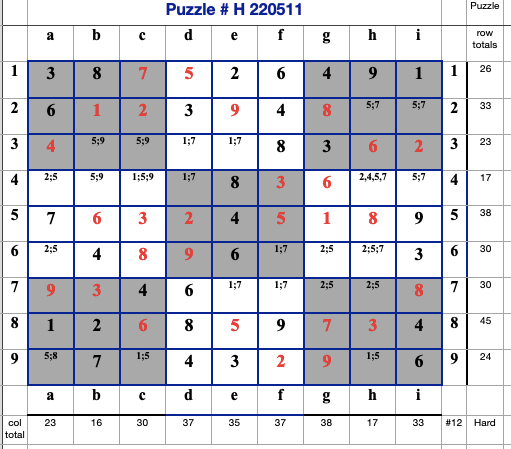
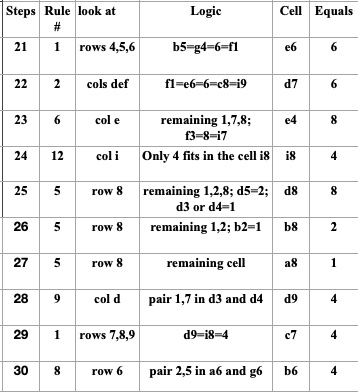
Step # 24, looking at Column i there is only one digit (4) that can fit into cell i8. So cell i8 = 4. [Francis’ Rule 12].
For Row # 8, there are three cells remaining for three digits of 1, 2, and 8. As cell d5 = 2; and cell d3 or d4 = 1, cell d8 = 8. [Francis’ Rule # 5]. Step # 25. The remaining two digits for Row # 8 are now 1, and 2. With cell b2 = 1, cell b8 = 2. (Step # 26). The remaining cell a8 in Row # 8 is equal to 1. (Step # 27).
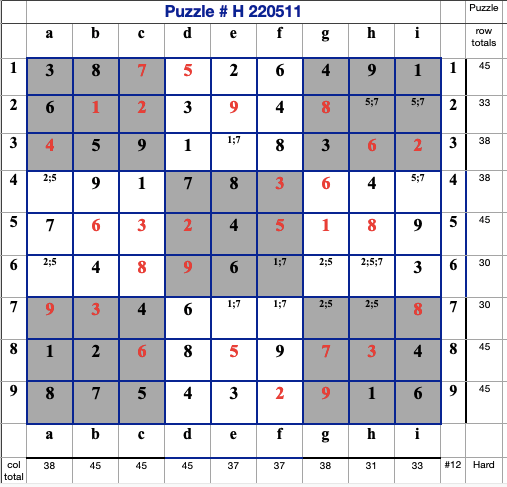
For Column d, if we pair 1, 7 in d3 and d4, we can discover that cell d9 = 4. [Francis’ Rule # 9]. Step # 28.
Looking at Rows # 7, 8, and 9, we have cell d9 = cell i8 = 4, and therefore cell c7 = 4. [Francis’ Rule # 1]. Step # 29.
In Row # 6, if we pair 2, 5 in cell a6 and cell g6, we have cell b6 = 4. [Francis’ Rule # 8]. Step # 30.
Looking at Rows 4, 5, and 6, we can see cell b6 = cell = e5 = 4 = cell i8. So, cell h4 = 4. [Francis’ Rule # 1]. Step # 31. Then looking at Columns g, h, and I, we have cell i1 = cell g5 = 1 = either cell e7 or cell f7 and therefore cell h9 = 1. [Francis’ Rule # 2]. Step # 32.
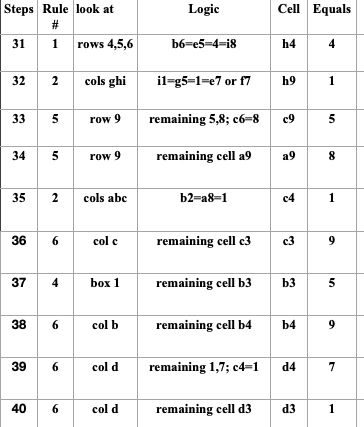
The two remaining cells of Row # 9 can now be deduced. Cell c9 = 5 and cell a9 = 8. [Francis’ Rule # 5]. Steps # 33 and 34.
Francis’ Rule # 2 can be applied to find cell e4 = 1 : cell b2 = cell a8 = 1. (Step # 35).
The next five steps # 36 to 40 concern the last remaining cell for their respective categories - Column c, cell c3 = 9 [Francis’ Rule # 6]; Box # 1, cell b3 = 5 [Francis’ Rule # 4]; Column b, cell b4 = 9 [Francis’ Rule # 6]; Column d, cell d4 = 7 and cell d3 = 1 [Francis’ Rule # 6].
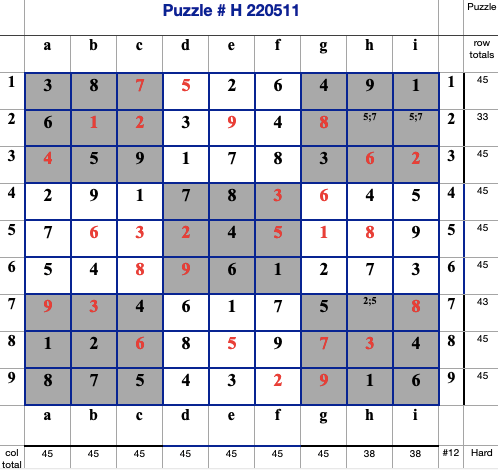
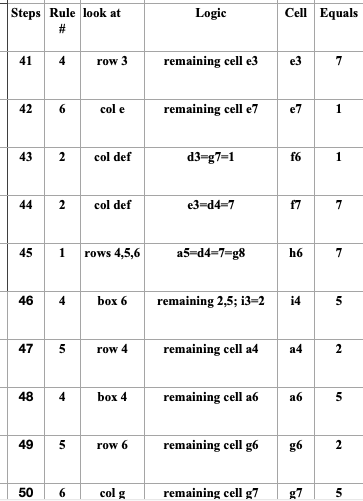
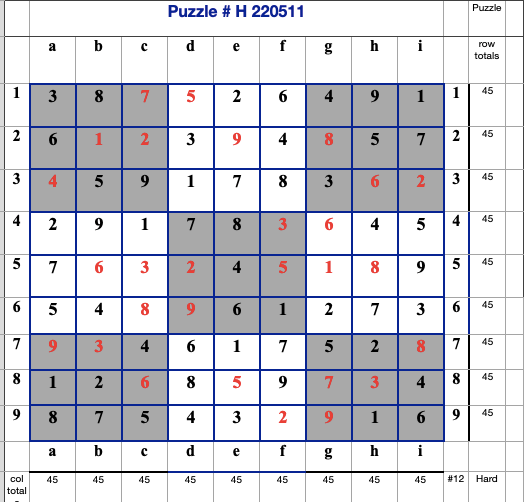
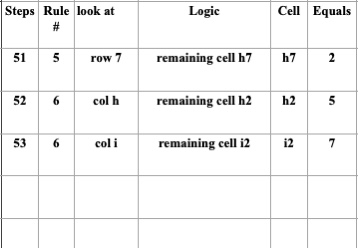
The logical steps from # 41 through to # 53 are tabulated below. The solution to all the fifty-three cells can be seen in the photograph of the final Sudoku grid. Most of the cells are those of the remaining cells for Boxes # 6 and # 4; for Rows # 3, # 4, # 6 and # 7; for Columns e, g, h, and i
 English