
Flannan Isle
Source: https://h2g2.com/edited_entry/A1061335
The light of the Flannan Isle lighthouse used to flash twice every 30 seconds. In good weather, it could be seen from 20 miles away. More often than not, mist enshrouded the island and visibility was markedly reduced. At such times, the value of the beacon to local shipping was incalculable. A three-man crew maintained the lamp at the top of the lighthouse. A rotation system ensured a change of personnel every 14 days. Once a fortnight, a service vessel came from Breasclete and a new crew would be installed. Flannan Isle was not a place to stay for any length of time.
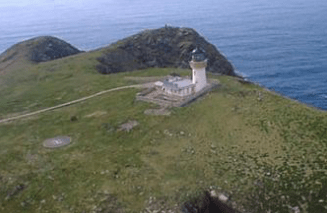
At 23 metres in height, the lighthouse was - and is - an unremarkable structure. Built in 1899 on the largest of seven rocky outcrops, it is situated some 15 miles west of the Isle of Lewis, on the outer fringes of the Hebrides. On 7 December, 1900, Head Keeper James Ducat arrived at the lighthouse to begin another tour of duty. His First Assistant, William Ross, had been taken ill and a local man, Donald Macarthur, had taken his place. Macarthur was an Occasional Keeper, who only filled in when regular crew members were unavailable. Second Assistant Thomas Marshall made up the trio.
Accompanying the three men on the relief vessel was Robert Muirhead, the Superintendent of Lighthouses. Routine inspections were a part of his brief and Muirhead always liked to keep in close touch with the men under his supervision. The Superintendent spent some time on the island, reassuring himself that everything was running smoothly. He had a brief discussion with the Head Keeper concerning improvements in monitoring, then bade him and the others farewell. He shook each man by the hand as he departed the island. The Superintendent was the last person to see any of them alive.
During the following week, as was standard practice, the island was kept under periodic observation from land. A telescope would be trained on Flannan Isle at regular intervals. In case of emergency, the lighthouse-keepers could hoist an appropriate flag and assistance would be sent out to them. The lighthouse was often obscured by mist, however, and there was no guarantee that the signal would be seen. It was this very problem that Ducat and Muirhead had been discussing on the 7 December.
During the two weeks thereafter, a heavy mist enveloped the island. The lighthouse would not be visible again from land until 29 December. The light from the lamp was easier to make out. Night observations were also a matter of routine. The lamp was visible on the 7 December, but was obscured by bad weather on the following four evenings. It was seen again on the 12 December. After that, it was not visible for over a fortnight.
On the 15 December, the SS Archtor was in the vicinity of the island. At close to midnight, Captain Holman looked out from the deck of the steamer, expecting to catch a glimpse of the light from Flannan Isle, as per usual. Holman was close enough to the island and the weather sufficiently moderate for him to be certain to see it. But no light was visible. The relief vessel from Breasclete did not arrive at Flannan Island on 21 December. A run of particularly bad weather had delayed the SS Hesperus and it was unable to reach the lighthouse until noon on Boxing Day, five days later.
As a matter of protocol, the lighthouse crew were expected to assist the incoming men, who would row from the Hesperus in a smaller boat to land on the island. A flag was usually flown to show that the incumbent crew had spotted the relief vessel and the men themselves would come out to greet the new arrivals. On this occasion, however, as the Hesperus drew close to the island, there was no flag flying and the lighthouse crew were nowhere to be seen. Captain Harvie, on board the Hesperus, gave orders to sound the siren. There was no response.
The steam whistle was also blown, to similar lack of effect. The boat would simply have to land at Flannan Isle without the usual assistance. Joseph Moore, the Third Assistant Keeper, jumped onto the landing craft alongside the Hesperus Second Mate, McCormack and together they rowed ashore. With nobody to assist them from the landward side, it was a difficult job to pull up the boat. Moore had to jump ashore himself to grab the mooring rope and throw it aboard. As McCormack secured the launch, Moore went up to check on the Station.
The outer door to the lighthouse was locked. Moore had a set of keys. He unlocked the building and went inside. The place was deserted. There was no sign of Ducat, Marshall or Macarthur. The clock on the inner wall had stopped. There was no fire in the grate and all the beds were empty. A meal had been prepared but was uneaten.
Moore hurried back to the launch. Breathlessly, he explained to McCormack that the crew were missing. The Second Mate joined him ashore and together the two men mounted a thorough search of the Island. The original crew were not there. They had simply disappeared. Moore and McCormack returned to the Hesperus and gave Captain Harvie the bad news. He instructed the Third Assistant to return to the Island with three others to take temporary charge of the lighthouse. Meantime, the Hesperus would return to Breasclete to inform the relevant authorities.
A telegram was sent by Harvie to the Secretary of the Northern Lighthouse Commissioners later that same day, informing them of the disappearance. On Flannan Isle, Joseph Moore and the others made an even more rigorous search of the lighthouse and a picture of events soon began to emerge. As far as they could make out, everything had been running smoothly on the island until the afternoon of the 15 December. Accurate record-keeping was mandatory for all lighthouse crew and the Head Keeper, Ducat, had conscientiously compiled reports up until the 13. Draft entries for the 14 and 15 December had been written up on a slate. There had been a storm on the 14, according to the draft, but by the next morning it had blown itself out. There was no indication of any further problems.
Whatever had happened to the three men, it had happened to them that afternoon. Superintendent Muirhead joined the others at Flannan Isle on 29 December. His official report is the most detailed account of the state of the island at that time. The storm on the night of 14 December had clearly caused substantial damage. The jetty was warped and the railings were clearly battered. A store containing mooring ropes and crane handles had been washed away. The ropes from the box had become entangled on a temporary crane some 70 feet above the normal level of the sea.
Muirhead concluded that the men had left the lighthouse in order to secure this store against the storm. They had taken wet weather clothing and locked the outer door behind them. Then, Muirhead believed, they had either been blown off the edge of the rocks or - more likely - an unexpectedly large wave had swept over the top of them and dragged them out to sea. The first theory could be discounted, as the wind that day had been in a Westerly (uphill) direction. It was Muirhead’s conclusion, therefore, that a freak wave - referred to in his report as a roller - was ultimately responsible for the men’s disappearance. The sea had claimed them and nothing could have been done to prevent it. A new crew was installed on Flannan Isle and efforts were made to increase the effectiveness of daily monitoring. But the memory of the disappearance lived on.
In 1912, Wilfrid Gibson published his famous poem, Flannan Isle. The piece lacked historical accuracy, but it created a disturbing sense of danger and uncertainty. In many ways, it is this work, rather than the actual events, which captured the imagination of the public. It has inspired music and fiction, and the inevitable crackpot theories. Aliens, mermaids and sea monsters have all been postulated as alternative explanations for the disappearance.
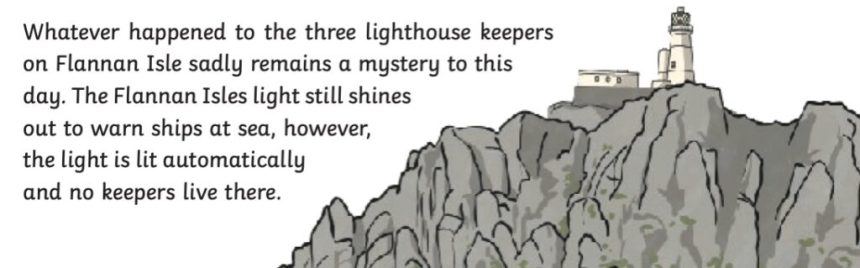
But no-one seriously disputes the findings of Superintendent Muirhead. It was not aliens or sea monsters that killed the unfortunate Keepers of Flannan Island - it was the Atlantic Ocean.
The History of Flannan Island:
Eilean Mor, The Island of the Dead, is a major island of Flannan Isles which is a group of 7 main islands with about 45 rocks and islets. Flannan Isles, also known as The Seven Hunters, is a uninhabited archipelago located 15-miles northwest of Lewis (Hebrides) island. Before the Flannan Isle Lighthouse was built, The Seven Hunters were a hazardous group of isles so named for destroying ships en route to Scottish Ports.
The Flannan isle lighthouse was built in by 1899 by David Alan Stevenson and Charles Stevenson Eilean Mor (Big Isle). The disappearance happened one year later; in December 1900, three lighthouse keepers at the new lighthouse mysteriously disappeared.
It was noticed on 15 December that the light had not been lit in the lighthouse, but bad weather prevented anyone getting to the island until 26 December. The lighthouse tender, the Hesperus, went to the island with a new set of keepers, but the three who were supposed to be there had gone - vanished. The lighthouse was deserted, with the lamps primed and ready for lighting. There was a diary entry made on the morning of 15 December that the lamp should have been lit, but no more.
Explanations put forward have included a freak wave, and a terrible row in which two were killed and the murderer committed suicide - but no bodies were ever found. Some accounts say there was a half-eaten meal on the table and that furniture had been overturned. A Board of Inquiry could not come up with an explanation, though the investigations are well documented.
The Poem by Wilfrid Wilson Gibson was written in the year 1912.
THOUGH three men dwell on Flannan Isle
To keep the lamp alight,
As we steered under the lee, we caught
No glimmer through the night.”
A passing ship at dawn had brought
The news; and quickly we set sail,
To find out what strange thing might ail
The keepers of the deep-sea light.
The Winter day broke blue and bright,
With glancing sun and glancing spray,
As o’er the swell our boat made way,
As gallant as a gull in flight.
But, as we neared the lonely Isle;
And looked up at the naked height;
And saw the lighthouse towering white,
With blinded lantern, that all night
Had never shot a spark
Of comfort through the dark,
So ghostly in the cold sunlight
It seemed, that we were struck the while
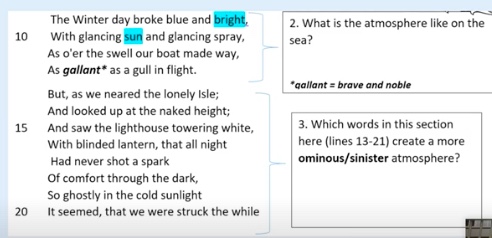
Question # 3: Which words in this section here create a more ominous / sinister atmosphere?
With wonder all too dread for words.
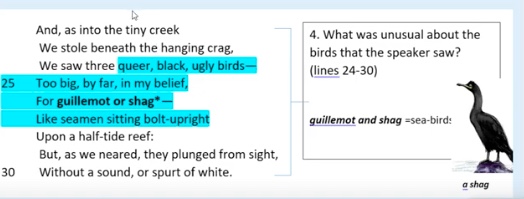
And, as into the tiny creek
We stole beneath the hanging crag,
We saw three queer, black, ugly birds—
Too big, by far, in my belief,
For guillemot or shag—
Like seamen sitting bolt-upright
Upon a half-tide reef:
But, as we neared, they plunged from sight,
Without a sound, or spurt of white.
And still to mazed to speak,
We landed; and made fast the boat;
And climbed the track in single file,
Each wishing he was safe afloat,
On any sea, however far,
So it be far from Flannan Isle:
And still we seemed to climb, and climb,
As though we’d lost all count of time,
And so must climb for evermore.
Yet, all too soon, we reached the door—
The black, sun-blistered lighthouse-door,
That gaped for us ajar.
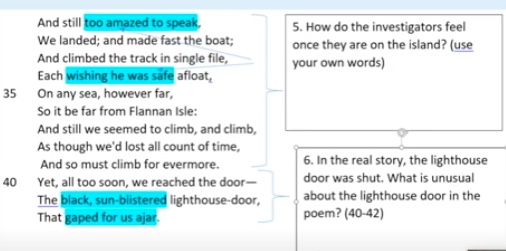
Question # 6: In the real story, the lighthouse door was shut. What is unusual about the lighthouse door in the poem?
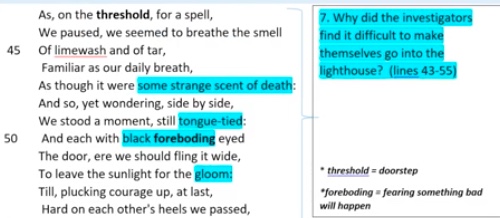
As, on the threshold, for a spell,
We paused, we seemed to breathe the smell
Of limewash and of tar,
Familiar as our daily breath,
As though ‘t were some strange scent of death:
And so, yet wondering, side by side,
We stood a moment, still tongue-tied:
And each with black foreboding eyed
The door, ere we should fling it wide,
To leave the sunlight for the gloom:
Till, plucking courage up, at last,
Hard on each other’s heels we passed,
Into the living-room.
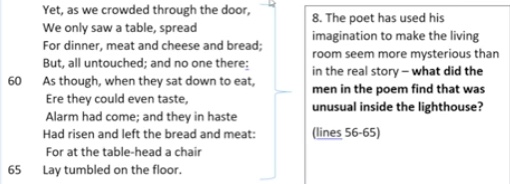
Yet, as we crowded through the door,
We only saw a table, spread
For dinner, meat and cheese and bread;
But, all untouched; and no one there:
As though, when they sat down to eat,
Ere they could even taste,
Alarm had come; and they in haste
Had risen and left the bread and meat:
For at the table-head a chair
Lay tumbled on the floor.
We listened; but we only heard
The feeble cheeping of a bird
That starved upon its perch:
And, listening still, without a word,
We set about our hopeless search.
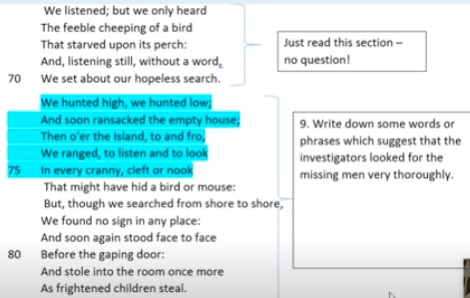
We hunted high, we hunted low;
And soon ransacked the empty house;
Then o’er the Island, to and fro,
We ranged, to listen and to look
In every cranny, cleft or nook
That might have hid a bird or mouse:
But, though we searched from shore to shore,
We found no sign in any place:
And soon again stood face to face
Before the gaping door:
And stole into the room once more
As frightened children steal.
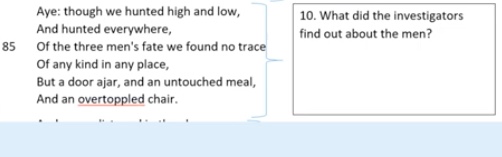
Aye: though we hunted high and low,
And hunted everywhere,
Of the three men’s fate we found no trace
Of any kind in any place,
But a door ajar, and an untouched meal,
And an overtoppled chair.
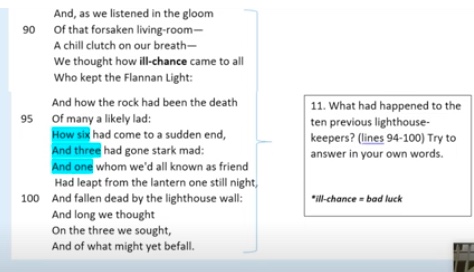
And, as we listened in the gloom
Of that forsaken living-room—
A chill clutch on our breath—
We thought how ill-chance came to all
Who kept the Flannan Light:
And how the rock had been the death
Of many a likely lad:
How six had come to a sudden end,
And three had gone stark mad:
And one whom we’d all known as friend
Had leapt from the lantern one still night,
And fallen dead by the lighthouse wall:
And long we thought
On the three we sought,
And of what might yet befall.
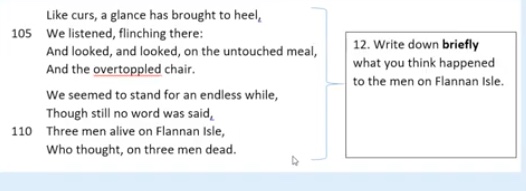
Like curs, a glance has brought to heel,
We listened, flinching there:
And looked, and looked, on the untouched meal,
And the overtoppled chair.
We seemed to stand for an endless while,
Though still no word was said,
Three men alive on Flannan Isle,
Who thought, on three men dead.
Source of the Questions: https://youtu.be/LQGJotY18d4. Year 7 Poetry Flannan Isle.
 English