
One Country Two Systems 一国两制
It is best to start this article with the history of how Hong Kong came to exist. The following 12-minutes video, already viewed by more than 2 million people, is perhaps a good starting point. Let us view this video first, shall we? https://youtu.be/69EVxLLhciQ
A brief summary of the main points in the history of Hong Kong goes like this: (1) At the end of the first opium war circa 1842, China ceded the freehold of Hong Kong Island to Britain. [see https://www.britannica.com/topic/Opium-Wars ]
(2) Several opium wars later, in 1898, China signed a 99-year lease agreement with Britain for the British to occupy a portion of China’s peninsular known as the New Territories.
(3)The two countries - China and Britain agreed that Hong Kong (both the Hong Kong Island and the New Territories) would be returned to China in the year 1997. Negotiations as to how a smooth handover between the two countries conducted in the years 1980 to 1984.
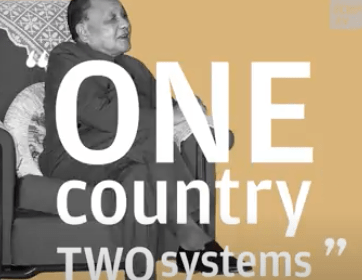
(4) China’s president Deng Xiaoping called the relationship of Hong Kong with China after the handover as “one country, two systems”. The two countries then signed a joint declaration in 1984, setting out China’s basic policies towards Hong Kong after 1997. The main legislature to be operated after 1997’s handover was called “The Basic Law of Hong Kong”.
Articles 22 and 23 are two sections of the Basic Law that are causing problems of interpretation in Hong Kong, between the pro-democracy faction and the pro-China faction.
Articles 22 and 23 of The Basic Law of Hong Kong have been under the microscope of politicians in Hong Kong, and China for a long time. I develop an interest in the topic about a year ago when Hong Kong Commercial Radio’s Chip Tso alerted his listeners about his concerns regarding the differing interpretations of these articles. Hong https://youtu.be/qtom_T9-g08.
Briefly, Article 22 states that no department or province of China can interfere in the affairs of the Hong Kong Special Administrative Region.
For entry into Hong Kong, people from other parts of China must apply for approval.
Article 23 says that Hong Kong shall enact laws on its own to prohibit any act of treason, secession, sedition, subversion against the Central People’s Government, or theft of state secrets, to prohibit foreign political organizations or bodies from conducting political activities in Hong Kong, and to prohibit political organizations or bodies of Hong Kong from establishing ties with foreign political organizations.
Previous Chief Executives of Hong Kong trying to enact Article 23 had been met with massive protests by the Hong Kong public.
Let us now consider the facts to date and then let us project out into the future, after 50 years of ‘one country, two systems’ rule in Hong Kong.
The first premise is the fact Hong Kong belongs to China. Hong Kong was ceded to the British only because China was then forced into that situation, the population weakened by the effects of opium, and the Chinese Empire weakened by corruption.
Then, the ‘one country, two systems’ rule was cleverly coined by Deng Xiaoping, who knew that China, in 1997, needed to depend on Hong Kong as an agent for Chinese goods going into the Western world.
A time frame of fifty years was cleverly set by Deng who had envisaged that by the year 2047, China would not likely be dependent on Hong Kong for her trading activities with the western countries.
Therefore, by 2047, Hong Kong will have to integrate into China as best she can.
It is impossible to think of Hong Kong as an independent country like Singapore. Hong Kong has no military to help defend her boundaries. Hong Kong is so physically attached to China. Hong Kong business community has by now (2020) established business connections with its Chinese counterparts.
Lastly, it is not right for criminals who have violated the law of Mainland China can use Hong Kong as an escape route for settling to a western country.
然我们先看看已下的视频:https://youtu.be/69EVxLLhciQ
一八四二年 - 香港岛割让给英国。 一八九八年 - 鸦片战争结束后,香港的新界被租借给英国99年。
香港成为繁荣的英国殖民地,因为香港通过英国的联系成为中国共产党国家与世界民主西方国家之间的中介。
中英两国一致同意,香港(香港岛和新界)的主权将在1997年恢复到中国。 两国于1984年签署了一项联合声明,阐明了1997年后中国对香港的基本政策。1997年移交后要运作的主要立法机构被称为“香港基本法”。
长期以来,《香港基本法》第二十二条和第二十三条一直是香港和中国政界人士的关注对象。 《基本法》第二十二条和第二十三条在民主派和亲中国派之间引起了香港的解释问题。
香港历届行政长官试图制定第二十三条的时候,遭到了香港公众的大规模抗议。
现在让我们考虑一下迄今为止的事实,然后在香港实行“一国两制” 50年规则之后,对未来进行展望。
第一个前提是香港属于中国。香港被割让给英国是因为中国随后被迫陷入这种局面,人口因鸦片的影响而削弱,中华帝国因腐败而被削弱。
后来,邓小平巧妙地提出了“一国两制”的规则,他知道中国在1997年需要依靠香港作为中国商品进入西方世界的代理。
邓小平巧妙地设定了五十年的时间框架。邓小平曾设想,到2047年,中国与西方国家的贸易活动将不太可能依赖香港。
因此,到2047年,香港将不得不尽其所能融入中国。
不可能将香港视为像新加坡这样的独立国家。香港没有军队来保卫自己的边界。香港是如此贴近中国。截止到2020年,香港商界已经与中国内地企业建立了业务联系。
最后,违反大陆法例的罪犯不可以利用香港作为逃往西方国家的逃生途径。
 English